Is Being A Father Worth It?

Getting married, and having children can be pretty scary. We are the generation who values our careers, assets, and freedom deeply. We don’t usually engage in matters that can endanger them. And if ever we do, we want to make sure it is worth it. This is why only 30% of millennials have a family of their own. We are more practical and analytical compared to the previous generations. We always count the costs before we make a move.

The unique parent-child relationship alone makes being a father worth it. The moments you share together, the lessons you learn from each other, the love you give to one another. It is a special bond you do not want to miss in your lifetime.

As your brother who is already married with two kids, I hope these insights about being a father will help you. Read on to learn about the rewards and the changes that fatherhood can make to your life.

Dad with kids in the car.
Playing and capturing these special moments with the kids while waiting for my wife to finish her bank errand.

How do first-time fathers feel?

Men tend to be more silent about their feelings, but that does not mean they do not struggle with them. Many assume it is only mothers who experience an emotional roller coaster ride when they give birth. Expect your community will show more support to your wife and newborn than you; so stay strong. Listed below is a heads-up of the common emotions you may feel as a first-time father based on my experience:

  • Excitement. Fatherhood starts at conception. And I have yet to know someone who is not excited to see their child’s face and hold him/her in their arms. It is something you look forward to each day.
  • Anxiety. Pregnancy entails a lot of risks. Not only to your child but also to your wife. You will find yourself edgy during this period, especially after your wife’s ultrasound examinations. Read about our mega yolk-sac pregnancy story here.
  • Joy. Meeting your little one for the first time will be one of the best moments in your life.
  • Confusion. As a first-time dad, be prepared for a ton of unsolicited advice coming your way. Be sure to do your homework or else you will be overwhelmed by the conflicting approaches to fatherhood and child care.
  • Drive. You will feel as if an inner switch has turned on upon seeing your child. You’ll suddenly become a man on a mission, doing everything in your capacity to ensure your family is well provided for.
  • Doubt. On the flip side of being on a mission, you will also find yourself regularly doubting yourself whether you can live up to the role of being a good father.
  • Exhaustion. I will not sugar-coat. Being a father is tough. Once the rush of excitement has worn off, exhaustion will set in. You will start to dread the sleepless nights, the unending cry, and the constant diaper change.

dad carrying a newborn on his shoulders.
Me and my five day old son (Joab).

Does becoming a dad change you?

Becoming a dad will change you in many ways. But amongst the most obvious ones is the shift in your paradigm that your life is your own. To say the least, fatherhood will turn you into a selfless person.

  • You will be more cautious about your actions and decisions. The consequences of our actions no longer just affect us. Because of this, we will be more careful about how we behave and where we get ourselves into. I love basketball. But I retired from playing the sport when I became a dad because the risk of getting a major injury is high. It is not practical to pay for the operation, the rehab, or even the opportunity cost of being out of work. I’d rather save the money for my children’s needs. See this post to find out why work is important to a family.
  • You will spend more time with your family than with friends. Say goodbye to your friends (in the meantime) when you become a dad. You would rather spend time with your kids than go out with them whenever you are free. You will realize that as much as you value friendships, family always comes first.
  • Your taste for music will change. Before I became a dad, I normally hummed to the music of Maroon 5 or Coldplay. Today it’s Baby Shark and 5 Little Monkeys Jumping On The Bed.
  • You will have more self-control. Children are adept at observing and imitating our behaviors. It is their most basic way to learn. Whatever they pick up from us, they will deem it as good. Knowing this makes us accountable for whatever we say and do, thus giving us a boost in maintaining our composure. See this article if you want to know more about the 7 keys to influencing your family.

Is being a father rewarding?

I know it’s a bit awkward to ask about what we can get in return as fathers. But this is a very valid question, humanly speaking. Nevertheless, for conversation’s sake, are there any rewards we can expect from taking care of our kids? Here are what I have experienced thus far:

  • Life is more meaningful. I always tell my wife that my life has become harder yet more meaningful since the day we started a family. It feels as if every drop of sweat I produce and every dollar I earn goes to something bigger than me. Before that, all I did was get myself the latest gadget and basketball sneakers.
  • Credibility. I am not sure if it’s just me. But being a dad gives you an avenue to influence others. People seem to listen to what you have to say, especially when they see your children are behaving properly. I feel the same respect toward other dads.
  • Community. One of the perks of being a dad is the community. You will eventually meet fellow parents whom you can exchange notes with. They can be your support group when the parenting journey gets tough. And as a bonus, you may even get the opportunity to do business together.
  • Favors. From time to time, you can get special favors from your parents or other relatives because of your children. You will receive extra rations of chips and chocolates which we adults enjoy too!
  • Fun times. Before our children were born, Lalaine and I never went to zoos or farms. All we want to do is to stroll around the shopping mall or chill in a coffee shop. But because of our kids, we now explore areas that are a bit more fun and educational.
  • Better relationship with your parents. Here is a big one for me. My relationship with my parents has never been better, ever since I became a parent myself. I have learned to appreciate them more because I now see what they have done for me as a kid. This also serves as a model for my children. If I want them to have a good relationship with me, I must also have a good relationship with my parents. I have talked about this further in a separate post: Do This If You Want Your Kids To Treat You Well.

With that said, you shouldn’t expect any tangible “rewards” in the first three years of parenthood. This is the period when you run on fumes and rethink the decision you made. But hang in there. Fatherhood will be one of the best jobs you’ll ever have.

kids at dreamplay.
Our first time at DreamPlay.

Summary

The way to enjoy being a father is to appreciate the relationship you develop with your child. You will struggle emotionally, mentally, and physically, but take heart because there are also a lot of perks you can delight in as a dad. Nevertheless, as fathers, we should focus more on giving rather than receiving. Continuously loving, even if we do not get anything in return.

See also

Sources


Follow the Journey

This journal is my way of making sense of the lessons from the journey. Get the next full entry delivered straight to your inbox.

How To Influence Your Family? (7 Keys)

Our family members are the most difficult people to influence. They know our flaws, they have seen our bad behaviors, and they have been directly or indirectly affected by our actions. Nevertheless, we, as fathers, have to influence our families toward right conduct, character, and beliefs.

Every family is unique. There is no one-size-fits-all approach to the way we influence our own families. But would it be a ridiculous idea to follow a few guiding principles to help us become better influencers? What I am going to share in this post today is inspired by what I learned from the following books:

Dining with parents
Dinner date with my parents.

The 7 keys to influencing your family

  1. Start with yourself.
    The common and overall premise of these books is that influence starts with ourselves. We can change other people’s behavior by changing our own. The truth is we are a product of another person’s influence. If we want to positively influence our families, we must be careful about whom we let influence us.
  1. Build strong and authentic relationships.
    People tend to follow personalities they either like or respect. My wife likes BTS and that is why she became part of the Army. I respect Warren Buffett, so I listen to everything he teaches about business and investing. Being an influencer in a family setting is the same, but a hundred times more difficult. As mentioned earlier, it is easy to like to respect people who are not part of the family because we do not see their flaws.

    It is not easy to like people who are in a bad mood. It is a challenge to respect people who have hurt you. The only way to build credibility in a family is by having authentic relationships. It is a relationship where we admit and accept each other’s imperfections, while we forgive and love one another continuously.
  1. Know what they want.
    Why do you want to influence your family? The reality is that there are people who do it for their own gain. No one wants to be “influenced” or “sold to.” You will lose your audience the moment they feel like you are hard-selling, or being manipulative. Everyone has their own will and desires. Nobody cares about what you have to say unless it benefits them. The key is to let them talk about what they want, and show them how to get it. Active listening is one of the skills we should learn as leaders of our families.
  1. Serve.
    Reciprocity is a powerful force. Humans have a natural urge to return a favor or pay back the gifts they received. As we make the first move to serve our family members, we do not only show how much we love them, but it also spurs them to do the same. Of course, we are not doing it for selfish reasons. It should not be an “I’ll scratch your back, and you scratch mine” kind of service. The goal is to simply present ourselves as a model of good behavior.
  1. Affirm every improvement.
    Do not criticize, condemn, or complain. Instead, give honest and sincere appreciation when your relatives display proper actions. Always try to catch them doing good and praise them immediately (and appropriately). You can give a pat on the back, a compliment, or a small token to make it tangible. As for me, there are times when I even treat them to a nice dinner to celebrate the moment.
  1. Tell them what they’ll lose not what they’ll profit.
    Have you ever wondered why limited-time offers and deadlines work so well? It is because the fear of loss is always greater than our desire for gain. People respond well to scarcity. If we want to become better influencers, we should learn how to speak in terms of what people will miss out instead of what they will obtain. This concept also applies to our presence. Family members tend to take us for granted if we always make ourselves available to them. Building a healthy boundary among relatives will encourage everyone to cherish the moment they’re together.
  1. Collaborate.
    I know you have experienced “the pull” to do something — or at least check out — what the majority of people in your circle are doing. We tend to copy one another. When we see three to five people gazing at the sky, our tendency is to also look at where they are looking at. This is called herd behavior. Inviting our relatives to work with us in our office, home, or church can help us become better influencers. This allows them to see things from our perspective. But the same is true the other way around. We will get to know our family members more when we also help them with their affairs.

These are the principles I generally use to influence my family. Yet, the application for this varies from relationship to relationship, and person to person. Read on to learn the different approaches to influencing your spouse, children, and other relatives. Please note this post is for information purposes only. I do not intend to give professional advice.

Little girl making face.
My daughter (Jrue) loves to make face. See her story here.

How to influence your spouse?

Submit yourselves to one another.
Our spouse should be the easiest person to influence. They are the people we spend most of our time with, and the ones who should know us from the inside out. We must, naturally, be influencing one another as we continue to spend our daily lives with each other. But I understand the struggle when our individuality kicks in; or the expectations we have from our spouses get broken.

Submitting to one another in marriage means we prioritize our spouse more than ourselves. If you are unsure how to do this, you may refer to the book of Ephesians in the Bible. Wives are instructed to submit to their husband’s leadership; while husbands are called to submit to their wives in a way that they will care for and protect them with their lives. It is generally a concept of reciprocation. We influence one another by outdoing each other in love and service.

How to influence your husband?

Mind your tone.
As a husband, here is a short insight for the wives who are reading this post. Men do not like to be told what to do. We will never bite into your ideas (no matter how good it is) if you deliver them as a command. If you want to influence your husband, mind your tone and present it as a suggestion. Best if you can frame it to make it look like his idea.

How do you influence children?

Model it.
We parents do not actually have to do anything to influence our children. We are naturally positioned to be their main influencers. They will copy everything we do as imitation is their most basic way to learn. Our work lies in making sure we are living the way we want our kids to behave. They still cannot differentiate right from wrong. Whatever they see us doing, they will deem it as good. If we want to influence our children toward good behavior, we must practice it daily in our lives.

How do you influence your parents?

Honor them.
Our parents can be the most difficult people to influence in our families. They have this notion that, as parents, they will always be far superior to us. We have to understand, that no matter how old we get, they will always see us as the fragile little boy or girl they have carried in their arms. That they are the influencers and not the other way around — since we are who we are right now because of them. I don’t know what is your relationship with your parents today. But I am sure you also have a unique form of parental issues just like everyone else.

Nevertheless, if you want to get a chance of influencing your parents, you have to take the initial step of honoring them despite the status of your relationship. Honoring means showing respect and recognizing them as the people who brought you to this world. To be clear, honor in this context is not something earned per se. It is a regard we give them simply because they are our fathers and mothers. Here are a few ways to honor our parents:

  • Thank them publicly.
  • Call them regularly.
  • Take them out to dinner.
  • Dedicate a portion of your income to them.
  • Tell them how you value them.
  • Share your failures and victories.
  • Gift them something extravagant.
  • Take care of them in their old age.
  • Invite them to your house.
  • Give them some alone time with your kids.

My wife and I had a rough relationship with my parents a few years back. We were first-time parents, and they were new grandparents. Everyone was adjusting to their new roles. Our view and application of child care clashed with one another. But things dramatically changed when we started to honor our parents. They now listen to our ideas and respect the decisions we make as a family — even when they do not agree 100%.

How do you influence your siblings?

Be a comrade.
One of the huge barriers to influencing our siblings is rivalry. Most of us tend to compete with one another instead of supporting each other as brothers and sisters. It is difficult to influence our siblings positively if they see us as a threat. Below is a list of dos and don’ts to signify that we are a comrade, not an enemy:

  • Do not give unsolicited advice.
  • Do not flaunt your achievements or possessions.
  • Talk more about your failures and the lessons you learned.
  • Make them talk about themselves more.
  • Pay for their food.
  • Better to ask questions than make statements.
  • Greet them with a hug, or a pat on the shoulder/back.
  • Let them know you are there for them.
  • Listen and be interested in what they are saying.
  • Go on a trip with them.
Chan Family Picture
Triple birthday celebration. (Mine, my sister’s, and mom’s). October 2019.

Summary

Influencing our family begins with ourselves. It is an overflow of the good habits we practice daily. It is about encouraging them to become better primarily for their own benefit, not ours. But being an influencer doesn’t guarantee we will be able to influence every person in the family. We only serve as a spark, it is up to them whether they will follow through or not.

See also

Sources


Follow the Journey

This journal is my way of making sense of the lessons from the journey. Get the next full entry delivered straight to your inbox.

Why Is Work Important To A Family?

It is unusual for someone to pause and ponder on the importance of work to a family. Most people would simply go on with their workday because “it’s what all people do.” I admire you for taking a step back to see the bigger picture of why you are doing what you are doing.

Work, in general, enables families to provide for their needs. Their livelihood will allow them to put food on the table, a roof above their heads, and clothes on their bodies. But moreover, work also gives families other benefits, such as discipline, being part of a community, and a good name.

Work has many advantages for a family, but it can also bring negative effects if we are not careful. Read on to get more details about the benefits of work to a family. We’ll also look at whether working mothers are beneficial for their families or not. Please be advised, however, that this article is intended for information purposes only. The data presented here is based on our personal research and experience. We by no means intend to give professional advice.

Husband and wife having coffee at Tim Horton's
Coffee while waiting for our client.

The five benefits of Work to a family

  1. Your work will provide for your family’s needs and wants.
    This one’s too obvious I even considered cutting it off. But as I did my research, it seems working for your needs is not that obvious anymore. People today bite on the idea of getting paid without having a job. They like to travel the world or sit all day playing video games — and still make money. I’m sorry, but the notion of making money without working is a clickbait. It overpromises yet under deliver.

    Work is essential to a comfortable life. It has been this way for the past thousand years, and it still is today. As Proverbs 12:11 says, “Those who work their land will have abundant food, but those who chase fantasies have no sense.” True, there is such a thing as passive income. Still, it requires a good amount of work to achieve it.
  1. Your work will serve as an example to your children.
    One of the most effective ways to parent our children is through modeling. They may not always listen to what we say, but they sure observe our actions intently. Derek Jeter, a former baseball player, once said, “I looked up to my parents because they were very successful in what they wanted to do. I was lucky; I didn’t have to look far for role models.” When we work, we give our children ideas of what they want to do someday. It will encourage them to be disciplined, driven, and follow a career path.
  1. Your work can be a legacy for future generations.
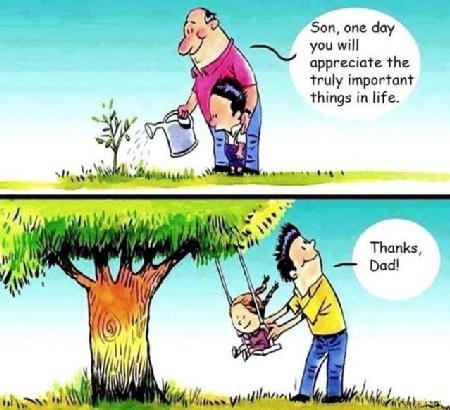
    I love the image below. It illustrates clearly how our work should ideally affect our children; and their children. Our work’s potential is not only limited to our present families but for the generations to come. Any seed we plant today, be it wealth, wisdom, or wellness, is a seed that can one day grow into a tree. A tree that serves as an inheritance our future family members can enjoy.
A comic strip of dad and son planting a tree.
A comic strip about a father planting a tree for his child, and grandchild. c/o LinkedIn.
  1. Your work brings honor and respect to your family’s name.
    Family names have always been a big deal, especially in ancient times. It is a brand of honor, respect, and loyalty. That is why successful parents even today practice the tradition of naming their kids after them with suffixes like junior, the second, or the third. They intend to impart the reputation and position they have earned to their children. Yet, not all people agree with this custom. They think parents who do this limit the freedom of their kids to establish their own identities. That they will always be under someone else’s shadow their entire life.
  1. Your work helps your family develop meaningful relationships.
    One of our closest friends was from work. We met this couple randomly at a business conference and have been in constant contact ever since. We meet them at least once a week over coffee, or dinner, and chat about life and career. They have witnessed my engagement with Lalaine, our marriage, and the start of our journey toward parenthood. Today, our children are good playmates!

Do working mothers benefit their families?

Working mothers generally benefit their families. But, if we solely talk about finances, they may not make a huge difference in the bottom line. The family might eventually need to hire someone to cover the duties at home while moms work outside — which only offsets the additional income.

In the book, The Millionaire Mind, 50% of about a thousand millionaires say their wives do not work outside their homes. This shows mothers do not necessarily need to have a job for the family to benefit financially. Of those who do, 7% are entrepreneurs; 5% are sales professionals; 4% are corporate middle managers; 4% are attorneys; 3% are teachers, 3% are senior corporate executives, and 2% are physicians.

Snack time with the kids after a successful delivery.

My wife works as an entrepreneur. She has an online jewelry business that she is so passionate about. I have expressed my desire for her to focus on being a housewife many times. Taking care of the house and the kids is already a full-time job! But she insisted on working as it is something she really likes to do. To put it plainly, my wife works not because she has to, but because she wants to. Here are the pros and cons I have observed so far:

Pros

  • Working mothers provide a financial safety net.
    My wife’s income is hers. She can do whatever she wants with her money. I do not obligate my wife to contribute to our household expenses, yet she has the option to do so if she wants to — and she does. She often uses her money to buy stuff that is usually not in the budget (like junk food, lol). But above all else, she also gives me peace of mind during the lean season. Her work, in a way, serves as an added layer of financial security when business is slow.
  • Work develops husband and wife teamwork.
    One beauty of having a working wife is we are (more often than not) on the same page. We both understand entrepreneurship and can empathize with one another. We even, at times, talk in jargon and use some business principles in the way we operate our family. Our teamwork has become more fluid overall ever since she started her own company.
  • Working moms allow themselves to become self-reliant.
    As husbands and dads, we pray (and do our best) to stay healthy and live the longest life possible to provide for our families. But the truth is, there are no guarantees. Life is fleeting and unpredictable. Allowing our wives to become self-reliant will give us confidence that no matter what happens, they will be able to take care of themselves and the kids.

Cons

  • Work can become a distraction.
    When Lalaine asked for my approval to start her own company a few years back, I told her my only condition was that family should always be the priority. In our house, she should be a wife first and a mother second. She can only work in her business when she’s done with all her duties at home. And she agreed.

    Fast-forward to today. The first thing she does in the morning is open her phone and respond to her clients. Many times, we have to eat our lunch late since she has to arrange her deliveries first. One night, at about ten o’clock, we had a heated exchange when I learned the kids haven’t taken a bath the whole day because she has to resolve a problem in her business. This con irks me so much!
  • Working mothers may become over self-reliant.
    As mentioned earlier, self-reliance is an advantage, but overly self-reliant mothers have negative effects on families. Based on reports, successful, independent women tend to struggle with dating, marriage, and parenting. The article did not mention clearly why this is so. But the speculation is that self-reliant women may see family life as an obstacle to their goals. There are times when I notice this in my wife.
  • Working moms are susceptible to burnout.
    Anger is a sign of burnout. It can make you flare up even for such mundane reasons. Lalaine is generally a level-headed person. But swimming between work and family life has perhaps shortened her fuse. She is now more easily enraged than ever before. There are times when I can tolerate it, and there are times when I couldn’t — especially when I am also stressed myself. It is an area in our marriage we need to work on.

Closing thoughts

Work is an essential element of a successful family. It brings many benefits besides being able to provide financially. Yet, it is also vital to take note of the detrimental effects when work has become the main priority. I hope you learned something important about your work today. I pray that you will find the proper balance between career and family life as they perpetually impact one another.

See also

Sources

  • What’s a realistic way to stop working 9-5 and still be able to live (without worrying about money constantly)? — Reddit
  • How to survive without a job? — Reddit
  • My dream job is to do nothing – to live without needing a job. What are my options? — Reddit
  • Derek Jeter — Wikipedia
  • When did naming your kid after yourself become a parenting faux pas? — Today’s Parent
  • Successful, Professional Women And Problems With Dating — CCFL Divorce Legal
  • Signs You’re Burned Out — Web MD

Follow the Journey

This journal is my way of making sense of the lessons from the journey. Get the next full entry delivered straight to your inbox.