What Is A Successful Family Life?

A family is a special unit in society. Managing it is one of the most challenging tasks we will ever face in our lives. I bet the majority of us would rather operate a company with hundreds of employees than a family of four. What makes running a family so complicated? The reason, perhaps, is that there are no clear measurements for success. I mean, what defines a successful family life? In business, it is the positive bottom line. In sports, it’s the trophy. In politics, the position. How about in the family?

A successful family life is one where all members work together to achieve a common goal. They live by their core values and have a clear vision of what they want to accomplish as a family. Everyone has a unique role, but they all see themselves as a unit, thus prioritizing their relationships above all.

I cannot emphasize the importance of having a purpose statement. Until we establish and clarify our family’s mission, vision, and values, we all will be like running endlessly on a treadmill; or drifting in the open seas. We need to identify what are the “wins” for us individually and collectively. In this way, we can draw a clear outline of what it means to live a successful family life for each of us.

The goal of this article is to help you lead a successful family life by identifying your wins. Read on to learn about the characteristics of a strong family, and how to improve your family life. You can also check out our family’s mission, vision, and core values here.

family of four
Enjoying one of our family photo sessions.

Characteristics of a successful family life

What does a successful family look like? It is difficult to give a definitive answer as each person’s response will vary. Everyone has different opinions about what makes a successful family based on their beliefs, tradition, and upbringing. Nevertheless, let us consider this objectively. Here is what the Bible and research have to say about having a successful family life.

What makes family life a success according to the Bible.

The overarching model of a strong Christian household is that every member of the family is serving one another out of love for Christ. (Ephesians 5:21) Families operating with a Christ-centered model tend to have a higher level of stability. They can love and serve each other regardless of their moods, or another person’s behavior. Their love is not based on feelings, but on reverence for Christ. It is like saying, “I love you no matter who you are, or what I feel, because of my love for Christ.” Listed below are 5 qualities of a Christ-centered family:

  • The wife submits to her husband. (Ephesians 5:22-24)
    God designed a woman to be a man’s “helper” since the beginning of time. But submission does not imply a wife is inferior to her husband. It simply denotes the Lord has given men and women their unique roles in leading a successful family. Submission means the wife recognizes her husband’s function as a leader and responds to him accordingly as a form of her obedience to God.
  • The husband leads, loves, respects, cares, and protects his wife with his life. (Ephesians 5:25-30)
    The marriage of a husband and wife parallels the relationship between the church and Jesus Christ. Wives shall submit to their husbands as the church submits to Christ. And just as Jesus loved the church — to the point of death — husbands are also commanded to do the same for their wives. This is an unselfish, unconditional love as seen in Christ, who gave Himself up for the church.
  • The husband and wife prioritize each other over their parents and children. (Ephesians 5:31-32)
    When a man and woman marries, they are now considered as “one flesh.” What this basically means is they are now totally dependent on each other, while being independent as a couple. They are to detach themselves from the temporal parent-child bond — and are united by the permanent husband-wife covenant. Next to God, married couples’ allegiance, devotion, priority, and affection are exclusively for among themselves. Their relationship with one another is a step higher than of their parents and children; or other relatives. This notion is widely known as leaving and cleaving in the Christian world. You can read my article about it here if you would like to learn more.
  • The children obey and honor their parents. (Ephesians 6:1-3)
    Christ-centered service is also applied in parent-children relationships. Whether parents set good examples or not, children should obey them as an act of their obedience to God. In turn, the Lord promises those who obey their parents to enjoy a prosperous and long life on Earth. To put it practically, perhaps the general principle is that obedience promotes self-discipline which can bring stability and longevity in their lives.
  • The father trains his children toward righteousness with respect — not rousing them into anger, which can lead to discouragement. (Ephesians 6:4)
    God gave fathers the special task of training their children. They should direct, correct, discipline, and nurture them toward God’s instructions. At the same time, fathers are also commanded not to provoke their children to anger, which can lead them to discouragement. They must not abuse their authority by giving unreasonable demands or establishing petty rules. In essence, a father should be a leader, not a boss.

family of four
Our little family of four.

What makes a successful family, based on research.

Now let’s take a look at some research. The University of Kentucky released a report about their case study of the common characteristics of strong families. Here are 12 things they discovered:

  1. Strong families commit themselves to promoting each other’s happiness.
    They foster family commitment by setting and carrying out goals together. Being able to get involved, and share meaningful experiences with one another, develops the sense of care and unity among family members. Commitment is a vital factor in establishing a strong family life.
  1. They express their appreciation for one another.
    More than simply feeling it, successful families express their appreciation toward each other. They make sure they let the other person know how they made them feel special through words and actions.
  1. They have healthy marriages that set the tone for their family’s overall well-being.
    A successful marriage helps other family members’ relationships with one another get better. This is because they tend to adapt the fundamental practices for a strong marriage, like clear communication, mutual respect, and transparency. Happy couples are also more likely to spill over their happiness into other relationships, which results in a positive family disposition overall.
  1. Strong families regularly spend quality time together.
    They are intentional in cutting down on outside engagements, so they can spend time with each other. Strong families frequently do things unitedly. They structure their lives in such a way that they can work, dine, have fun, and attend social events together.
  1. Successful families communicate openly.
    Family members value what each person has to say, or feel. They are comfortable voicing their own opinions and are open to feedback. Communication in strong families flows freely even when they do not agree on certain matters. In times of conflicts, they put it all out on the table and resolve it without prejudice.
  1. Proper nutrition, adequate rest, and regular exercise are the habits of strong families.
    Having a healthy lifestyle can be tied to healthy relationships. Members of successful families take care of their bodies, so they can function well individually and collectively. They give themselves time to manage stress, meditate, and maintain an optimal balance between work and family life.
  1. Healthy families are spiritual.
    They all share similar values and have a common moral compass to guide their lives. They practice spiritual disciplines such as praying, singing, and meditating on inspirational texts. Most, if not all, strong families live the golden rule by default: “Do unto others as you would have them do unto you.”
  1. Successful families deal with crises positively.
    They do not let misfortunes bother them. Strong families always search for the silver lining in any challenges they encounter. They stick together and work themselves out of the rubble. They see no crisis can overwhelm them as long as they have each other.
  1. They acknowledge and accept each other as a unique individual.
    Members of strong families know they have a special role in the family. They look beyond their imperfections and recognize their unique abilities. They accept one another’s needs and work on supporting each other. Every person in the family is free and does not need to live on pretense.
  1. Successful families stay in touch with their communities.
    They understand that no family is an island, and they are not sufficient on their own. Strong families recognize their need for community. They require the support of friends, relatives, neighbors, and family counselors. Successful families are humble enough to admit their inadequacies and are willing to reach out to other successful families when help is needed.
  1. Healthy families are quick to forgive.
    Mistakes, misunderstandings, and offenses are a painful part of life. But strong families always live each day in a fresh, full way by practicing forgiveness and letting go of the past. They refuse to nurse old wounds and move on to healing, peace of mind, and deepening of love. It is not an easy process, of course. But it is a process successful families are willing to undergo for the sake of developing healthy relationships.
  1. They enjoy each other’s company.
    Successful families laugh together. They foster humor, spontaneity, and wit. These help families develop a positive energy and environment. Strong families know how to have fun and genuinely enjoy one another.

How can I improve my family life?

As you read the characteristics of a successful family above, keep in mind that there is no perfect family. There will always be conflicts and misunderstandings no matter how hard we try to avoid them. What is important, however, is that, despite the family issues we face, we all strive to improve.

To close, here are 10 key statements from what we have learned today. Rate it from 1 to 10, so you can identify what areas of your family life are succeeding and which ones need improvement. Feel free to customize this list based on what you think is vital for your family.

  1. Our family has a clear purpose.
  2. We work together to achieve a certain goal.
  3. We have a strong marriage.
  4. Our love for each other is not based on emotions, but on a higher calling.
  5. Children are being trained and disciplined.
  6. We intentionally spend quality time and enjoy each other’s company.
  7. We resolve conflicts quickly and sincerely.
  8. We always keep in touch with friends, relatives, and communities.
  9. We have each other’s backs in times of trouble.
  10. We take care of our bodies, so we can better serve one another.

Closing thoughts

If you want to bring happiness to the world, go home and love your family.
Mother Teresa

So what’s your win? Is it the bottom line, the trophy, or the position? I do not want to sound spiritual, but as I pondered about it, my win is my family’s relationship with Christ. As long as we all walk together with Him, we have a successful family life.

See also

Sources

  • Instructions for Christian Households.
    Submit to one another out of reverence for Christ. — Ephesians 5:21
  • Wives.
    Wives, submit yourselves to your own husbands as you do to the Lord. For the husband is the head of the wife as Christ is the head of the church, his body, of which he is the Savior. Now, as the church submits to Christ, so also wives should submit to their husbands in everything. — Ephesians 5:22-24
  • Husbands.
    Husbands, love your wives, just as Christ loved the church and gave himself up for her to make her holy, cleansing her by the washing with water through the word, and to present her to himself as a radiant church, without stain or wrinkle or any other blemish, but holy and blameless. In this same way, husbands ought to love their wives as their own bodies. He who loves his wife loves himself. After all, no one ever hated their own body, but they feed and care for their body, just as Christ does the church— for we are members of his body. — Ephesians 5:25-30
  • One flesh.
    “For this reason, a man will leave his father and mother and be united to his wife, and the two will become one flesh.” This is a profound mystery—but I am talking about Christ and the church. However, each one of you also must love his wife as he loves himself, and the wife must respect her husband. — Ephesians 5:31-33
  • Children.
    Children, obey your parents in the Lord, for this is right. “Honor your father and mother”—which is the first commandment with a promise— “so that it may go well with you and that you may enjoy long life on the earth.” — Ephesians 6:1-3
  • Training a child.
    Fathers, do not exasperate your children; instead, bring them up in the training and instruction of the Lord. — Ephesians 6:4
  • Family Vitality: Characteristics of Strong Families — University of Kentucky

Follow the Journey

This journal is my way of making sense of the lessons from the journey. Get the next full entry delivered straight to your inbox.

Which Financial Tool Is Most Important?

Finding the right financial tools to manage your finances can be overwhelming. There are countless apps, software, and other programs available on the market today. What is good is you do not really need many tools to be effective in managing your finances. You only have to find a few essential ones and align them to the way you approach money management. If you are not sure where to begin, start with the most important one.

A budget planner is the most important financial tool you should have. Money management is about keeping track of your income and expenses. You can use budget planners to make sure your inflows are greater than your outflows. Without such a tool, you will be at risk of overspending.

The goal of this article is to give you an overview of the different financial tools available to you. Read on to learn the purpose of each tool and how to use it effectively. I will also share the list of financial tools I have, and the techniques for using them on a day-to-day basis. Disclaimer: The information contained in this post is for educational purposes only. It doesn’t intend to give professional advice.

books and office stuff
A peek at my home office.

Why are financial tools important?

Using financial tools is essential because they help you manage your money more effectively and efficiently. Working with numbers is a daunting task. These tools will make money management so much easier because all you have to do is input the amount, and it automatically does the accounting for you.

I doubt if anyone can get by without having at least one financial tool today. But let us say there is someone who can. The question then is, why don’t we take advantage of such tools? No matter how skilled a person is at manual computation, I bet he or she will still be more effective with a tool than without one. If it is a cost issue, well, the majority of financial instruments nowadays are either free or on a pay-as-you-grow basis. Meaning you only pay for the service once you have reached a certain threshold. As for the learning curve, most tools are generally easy to use, and they come with a video tutorial to help you. There are no compelling reasons not to use a financial tool.

Types of financial tools

  • Accounting software.
    This program is usually used by businesses to manage their finances, automate accounting workflows, and organize data among different departments. It is a complex tool that can also be developed to handle many financial tasks such as invoicing, budgeting, inventory management, and banking. Be sure to look for the essential features applicable to your business before choosing an accounting software. It can be a hassle to migrate your data from one tool to another. If you are looking for a recommendation, one of the reliable accounting software I found is Zoho Books. You can use it for free if your revenue is less than 50K USD per year.
  • Expense tracker.
    As the names suggest, this tool helps you keep track of your expenses. This feature is often already part of some accounting software or budget planners. But there are situations when tracking your spending can be a bit more complicated than usual. For example, during travel and events. If you are interested in this type of financial tool, check out Zoho Expense. It is the expense management tool used by many popular brands, like Puma, Food Panda, and Samsonite.
  • Budget planner.
    As mentioned at the beginning of this post, a budget planner is the most vital tool in money management. It helps you prevent overspending and thus leads you to a healthier financial life. Being able to stick to your budget is the main objective of this tool. So, it is essential to look for a software or an app that is pleasant to use and easy to access. What I have used so far are MoneyLover and Bluecoins. You can download these apps on your Android or iOS devices for free. But you have to pay to unlock the full features or remove the ads.
  • Billing solution.
    If you are in sales, this tool is a necessity. A billing solution allows you to quickly and easily collect payments from your customers. It also organizes and efficiently monitors which transactions are already paid, and which ones are not. Some services even have an automated billing feature that handles your customers’ regular recurring payments. Here are some of the noteworthy pay-as-you-grow billing solutions: Zoho Invoice (free forever) for crafting professional invoices; Zoho Subscriptions for recurring billing; Zoho Checkout for building custom checkout pages.
  • Inventory system.
    Managing your stocks well is crucial to your store’s overall reputation. You do not want to offer your customers products that are already out of stock. Or worse, deliver items they did not order. An inventory system helps you stay on top of your stocks. This tool manages your orders, tracks deliveries, and analyzes which goods have the highest demand. If ever you wondered what inventory system FedEx, DHL, and UPS are using, they all use Zoho Inventory.
  • Payroll manager.
    Managing your employees’ payroll is going to be one of the most dreadful tasks you will ever face as your business grows. It’s labor-intensive and error-prone. If you plan to build a team of more than ten people, investing in a payroll manager might be a smart move. This tool will help you manage and track your employees’ schedule, simplify the payroll process, and generate performance reports. If you need a simple yet powerful payroll management solution, take a look at Zoho People and Zoho Shifts.
  • Financial Calculator
    Making money-related decisions has never been easier thanks to financial calculators. Gone are the days when you need to memorize the formulas or ask accountants to do computations for you. Online calculators such as Calculator.net and Fncalculator.com can already help you calculate complex financial equations like taxes, mortgages, and return on investments.
  • Digital wallet.
    This tool makes it easier to transact online and offline. What it basically does is keep your financial information, and make it accessible via smartphone or other devices. Digital wallets are normally linked to your email address, phone number, debit/credit cards, bank accounts, and are secured by a password or fingerprint. Some options for the best e-wallets include PayPal, Google Wallet, and Alipay.
  • Mobile banking.
    A tool provided by banks to enable their customers to transact remotely. It is a convenient way to deposit and transfer funds using your smartphone. With mobile banking, you can skip the lines and do bank errands according to your own time. Furthermore, some digital banks also offer savings accounts that give higher interest rates than traditional banks.
  • Online trading platform.
    Growing our money is always a part of financial strategy. To survive is one thing, but we should also plan to thrive. That is why having easy access to various investment channels is an advantage. Online trading platforms help us to comfortably invest in mutual funds, equities, and other assets. For global trading, some of the best ones are eToro, xtb, and Trading 212.

What tools do you use in budget planning and management?

Spreadsheets and note-taking apps are the two main tools I use for budget planning and management. I use a spreadsheet to organize my data, and automate the computation using its formula function. While a note-taking app or service is for tracking my payables, receivables, and inventory.

I am the type of person who likes to try out a lot of different tools but ultimately uses the ones he is familiar with. I have already test-driven many financial apps, software, and web services. What I found out is that most of them can actually be replaced by simple spreadsheets and note-taking apps. Unless a tool is special enough, I tend to stick with the basics.

Financial tools and techniques

Below is a complete list of my financial tools, along with how I use them daily. You might be surprised at how simple they are despite the powerful ones I have listed above. I am currently managing a blog, a small e-commerce site, a few investments, and a family of four. I don’t think I need to subscribe to those tools yet.

  • Bluecoins: my go-to expense tracker.
    Tracking your expenses is tedious. What I do here is very straight forward. I open Bluecoins and record every amount I spent. With a shortcut on my phone’s home page, I can input expenditures in less than ten seconds. This helps me build the habit of taking note of my expenses. I also make sure they are recorded under the right categories. It enables me to view in the report which area I tend to spend the most.
  • Google Sheets: for planning my budget.
    I have a somewhat different approach to budgeting. It is called the zero-based budgeting system. I got it from Dave Ramsey. If you want to get an idea of how it works, I have written about it in this article; and also in this one. Unfortunately, most tools I have tested do not naturally support this kind of method. But I don’t mind. Google Sheets has worked well for me for the past five years. I bought an online tutorial for mastering Google Sheets called Better Sheets to help me design the spreadsheet I need. I wish to show you the actual sheet I made. Yet, I am afraid I may be the only person who will be able to understand it for now. It still needs to be polished. But here is the simplified version:
Total cash on hand100%$1,000
Budgets
Savings10%$100
Necessities30%$300
Transportation10%$100
Business/Investment15%$150
Debt payments15%$150
Giving10%$100
Fun/Travel/Entertainment10%$100
In summary, the spreadsheet will automatically distribute my income into their corresponding budgets — according to its percentage.
  • Google Calendar: to monitor my recurring bills.
    All my monthly, quarterly, and yearly bills are encoded into my Google Calendar. This helps me be on top of my payables and avoid getting penalized. To save time and put things more organized, I clustered all the liabilities into two days. All that’s due in the first half of the month will be paid on the 10th. And everything due by the end of the month shall be settled on the 25th.
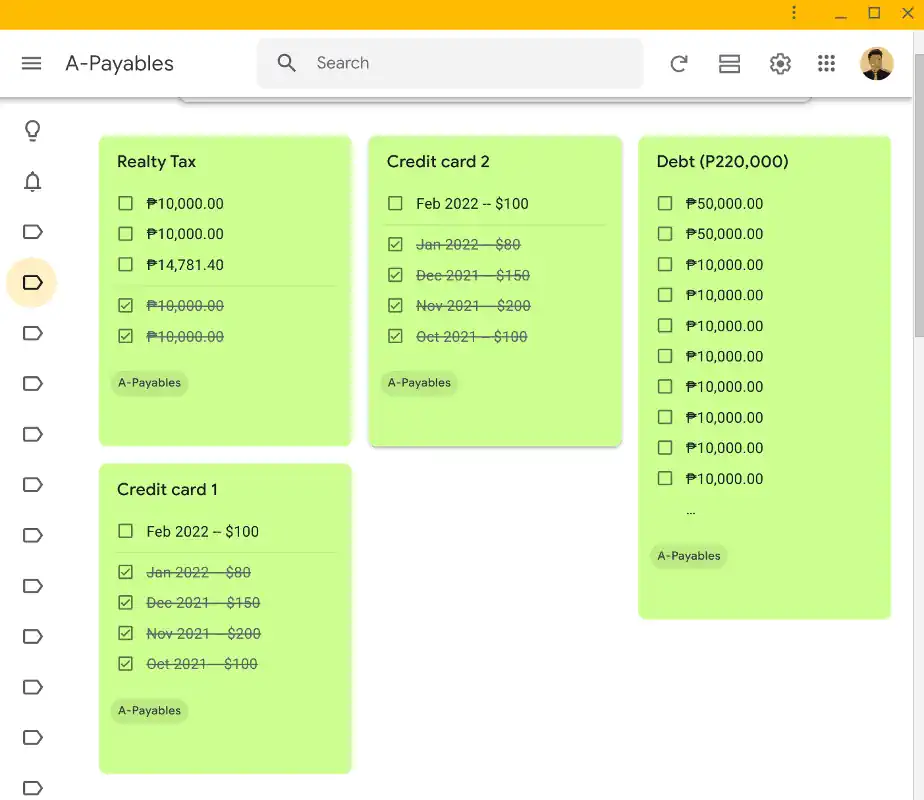
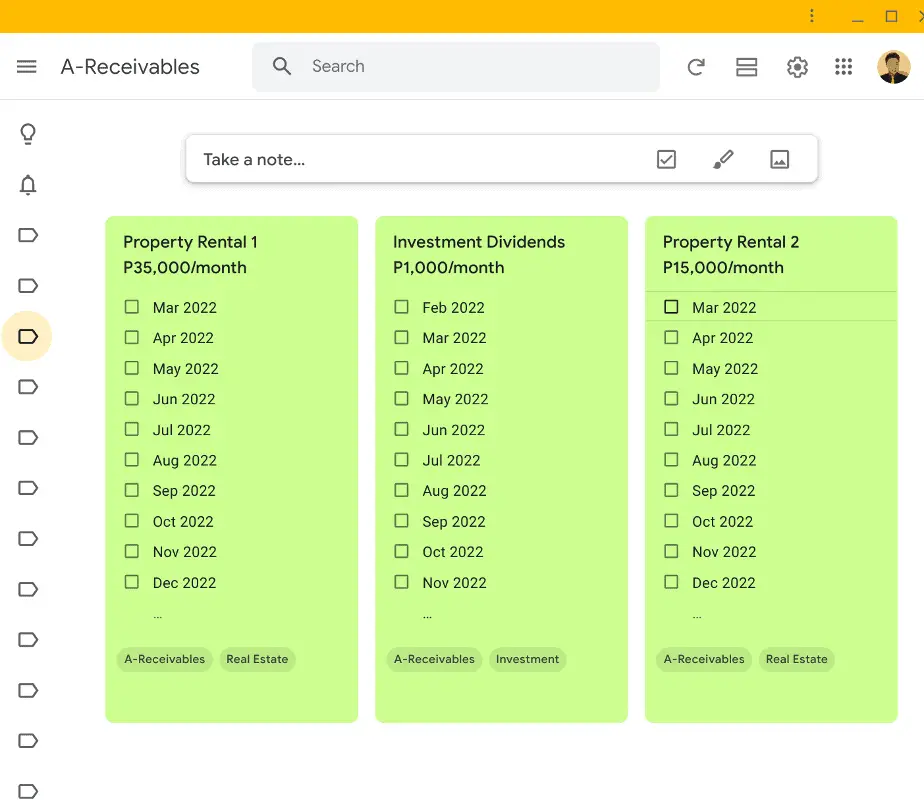
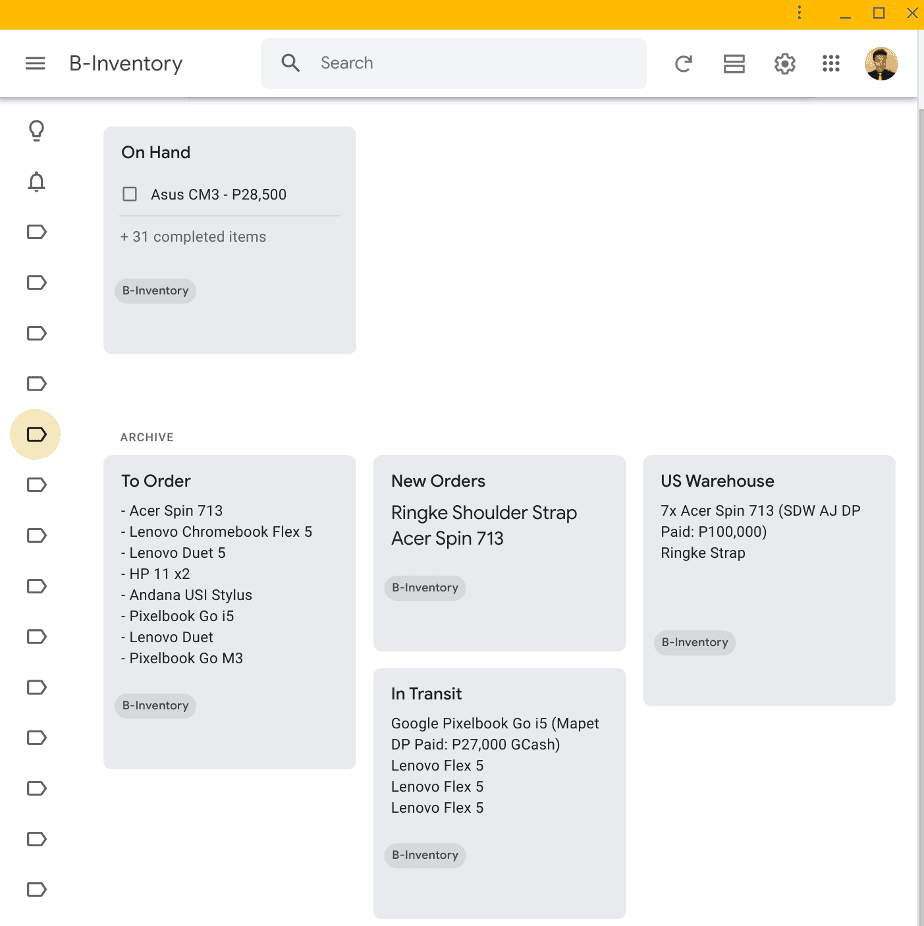
  • Google Keep: to keep track of my payables, receivables, and inventory.
    This is my favorite financial tool of all. I really enjoy working with Google Keep. It is actually a note-taking app where I monitor my payables, receivables, and inventory. This tool is very versatile. I have a lot of use for it, besides managing my finances. It can also serve as a shopping list, a dream board, and a clipboard.
Managing receivables on Google Keep.
I created a specific tag like “payables” so I can see all my notes related to payables. Side note: I included an “A” at the beginning, so the tag goes on top of my sidebar. I then make a note per account payable and break it into months, or according to my budget. I tick the checkboxes every time I make a payment.
Managing receivables on Google Keep.
The same technique applies to my receivables. I tick the checkboxes whenever I successfully receive payments from my tenants or customers.
Managing inventory on Google Keep.
Inventory management is a little different. As you can see, I have set up five notes to help me monitor the status of my orders. “To order” are all the products I plan to order from the supplier. “New orders” are the orders successfully placed. “US warehouse” is for orders already delivered in our US warehouse. “In Transit” is for orders on the way to our local warehouse. I cut and paste the entries to their corresponding notes whenever there’s movement. Once the items are in my possession, they will be then moved to the “On Hand” note where I tick the checkboxes once they are sold.
  • PayPal: for debit/credit card billing and check-out transactions.
    While most of my online transactions are through bank-to-bank transfer, it is an advantage to offer customers the option to pay via debit or credit cards. With PayPal, I have the ability to bill my customers via email or through a check-out page. Furthermore, PayPal can also serve as a digital wallet where I use it to make online purchases or transfer funds to other countries.
  • Payoneer: to accept funds from overseas affiliates.
    I can generally use PayPal for this purpose as well. But the problem is, it is not efficient. PayPal charges too much for this service. Plus, not all my affiliates abroad can transfer via PayPal. This is the reason why I use Payoneer. Having a Payoneer account is like having my own bank account in the US, UK, and Japan.
  • ING: for local fund transfers, bill payment, check deposit, and savings.
    This is my go-to mobile banking app. I use it to transfer funds, withdraw cash from ATM, pay bills, deposit checks, and finally park my unused cash. I also generally use BDO, BPI, and GCash. But here’s what I love about ING: 1. Check deposit. Other apps do not have this function. 2. Free fund transfer. But not real time since it’s via PESONet. But it is not a big deal to me since I usually pay in advance. 3. Withdraw cash at any ATM for FREE! No further explanation is needed 4. Generous interest rate. Money parked on ING will incur 2.5% interest per year. It’s much higher compared to other bank’s 0.125%.
  • COL Financial: for investing.
    This tool helps me invest in index funds regularly. COL Financial is an online trading platform based here in the Philippines. I am not yet into the global stocks, but I’m planning to go there soon. For now, I plan to bulk up my index fund portfolio a bit more before diversifying internationally. If you want to learn more about COL Financial, you can download this very short e-book I made.

Closing thoughts:

Money is only a tool. It will take you wherever you wish, but it will not replace you as the driver.
Ayn Rand

3 tools of financial managers

Personal finance is personal. It is an idea I have expounded on in a separate post. The general notion is about the essentiality of managing our own finances. There’s no other person who cares about our money more than we do. In a sense, we should all consider ourselves as financial managers. With that said, if ever I had to choose only three financial tools to manage my money, these would be my picks:

  • Budget planner: to control my cashflow.
  • Digital wallet or mobile banking: to accept payments and move funds.
  • Online trading platform: to allow me to invest regularly.

In the end, financial management is about making, keeping, and spending your money efficiently and effectively. And these are the basic tools that will help you accomplish them.


Follow the Journey

This journal is my way of making sense of the lessons from the journey. Get the next full entry delivered straight to your inbox.

Why Is Personal Finance Personal?

I’m a leave-it-to-the-professional type of person. I have the contact numbers of plumbers, electricians, architects, doctors, accountants, and lawyers saved in my phone book. In contrast to my wife, who loves to DIY — do it yourself — my default is to delegate every task outside my expertise. Delegating is one of the most important functions in leadership. But there are certain aspects of our lives we cannot fully entrust to others; one of which is personal finance.

Personal finance is personal because there are no standards for money management. Despite what books, courses, and financial advisors teach you, the way people handle their finances is uniquely theirs. There is no guarantee that what helped them succeed, will also bring you the same results.

In short, personal finance is different for each person. No one has the same goals as you. No one has the same behavior as you. And finally, nobody cares about your money as much as you do. This is why I discourage people from letting their financial advisors take the driver’s seat when it comes to their finances. Everyone should do their due diligence in learning how to manage their own money. Don’t leave this task solely to the professionals. Let them guide you, but always be on top of every financial move you make.

This post is about helping you get on top of your finances. Read on to learn why it’s important to manage your own money, and also get some tips on how to do it well. But as a disclaimer, this content is for informational purposes only. It does not intend to provide any professional advice.

Siblings with nanny since birth
Here is a photo of me, my siblings, and our nanny since birth.

Is personal finance good for you?

The initial step to money management is learning the subject of personal finance. Personal finance essentially teaches you how to make, keep, and spend your money efficiently. It covers topics about saving, budgeting, investing, insurance, taxes, retirement, and much more. But like many other good things, personal finance can also lead to something unpleasant.

In general, personal finance is meant to be used for your own good. It teaches you effective money management techniques that can result in a more disciplined and less-anxious life. Yet, personal finance also has the potential to cause negative effects when a person becomes obsessed with numbers.

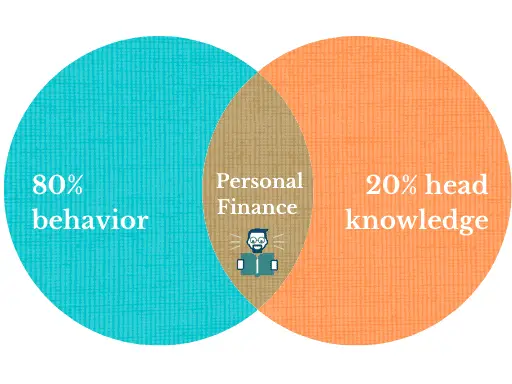
Money is neutral and how it affects our lives will be entirely based on our behavior towards it. To double down on what Dave Ramsey says, “Personal finance is 80% behavior and 20% head knowledge.” Whether you find personal finance to be positive or negative, keep in mind your attitude is the overall determining factor. This is the reason why money is often not the solution to our money problems.

Personal finance is 80% behavior and 20% head knowledge.
A visual representation of personal finance: 80% behavior, 20% head knowledge.

The positive and negative effects of personal finance (examples)

Positive

  • Control over your finances.
    Having control over your finances is the most basic positive effect of personal finance. You know where your money is going instead of wondering where it went. You are aware of your priorities, and have a clear line between your wants and needs. Moreover, you are also not easily captivated by advertisements and other promotional campaigns because you are well aware of your budget.
  • Better self-knowledge.
    Keeping track of your expenses is a core discipline in financial management. By doing so, you will be able to uncover a lot of information about yourself. Where am I spending the most? Is it on food, electronics, or travel? Where you put your money speaks a lot about what you value. It also, at the same time, exposes the areas in your financial life where you are most vulnerable.
  • Clearer financial goals.
    Financial freedom.” “Being wealthy.” That is what most people say when you ask them about their financial goals. But the truth is, the majority of them do not really know what they are talking about. Personal finance will help you clarify those goals. It will provide you with clear numbers, a series of actionable steps, and useful tools to achieve your targets.

Negative

  • Legalism.
    One of the destructive behaviors I have observed in personal finance is legalism. I know people who have become tightfisted as a result of their obsession with numbers. They are overly strict about how much money comes in and goes out each month. Nothing wrong with being zealous about your finances. But over zealousness to the point of legalism can lead to burnout, pigheadedness, and apathy toward others. I know because I have been one of them myself.
  • The risk of being scammed.
    Many fraudsters use personal finance as a gateway to scam people. They project themselves as financial gurus who will teach you how to become rich. They will entice you to get on their financial courses or buy into their get-rich-quick schemes by flashing their mansions and sports cars. Once you’re in, you’ll discover their materials are low-quality — and you’ll be continuously upsold to more products.
  • Self-centeredness.
    I personally struggled with this big time. I was so devoted to my financial goals that I became insensitive towards others. Every favor has a price — even from family members. I don’t do charity works. Every time I give, I expect something in return. The way I remedied this was by practicing generosity. To not get completely consumed by selfishness, I have committed to setting aside 5 to 10 percent of my monthly earnings for the purpose of giving. No strings attached. It was excruciating at first, but it got better overtime.

Why is personal finance dependent on your behavior?

Personal finance is a tool. And like any other tool, its effectiveness will be based upon how one uses it. Regardless of how educated you are about finance, it requires certain behaviors for it to be appropriately enforced in your life. Such behavior includes patience, diligence, and self-discipline.

The foundation of economic success

Dr. Thomas J. Stanley dedicated his life to studying millionaires. As part of his research for the book, The Millionaire Mind, he examined the behaviors of the wealthiest Americans, and he discovered they all share these characteristics: (Listed by order of importance)

  1. Integrity.
    Being honest and transparent was rated one of the two most crucial success factors by the large majority of millionaires. They said they became rich because they did not compromise their integrity. People tend to do business more with those who are trustworthy.
  2. Self-discipline.
    Webster defines self-discipline as “correction or regulation of oneself for the sake of improvement.” Discipline is tied with integrity, as being the most essential factor in economic success (see the table below). A disciplined person sets a goal, and finds ways to reach it. They manage their own lives well and are not easily sidetracked. Dr. Stanley puts it this way, “Disciplined people could live in a warehouse filled with top-brand alcoholic beverages and not indulge themselves.”
  3. Social skills.
    It’s rare for anyone to become successful in anything without support from others. Thus, getting along with people is the third-highest rated behavior of the rich. Most millionaires would even choose social skills over intellect. Socially skilled people have strong leadership qualities, have the ability to communicate their ideas, and have the humility to learn from others.
  4. A supportive spouse.
    Almost all millionaires are married and most of them credit their success with having a supportive spouse. They believe having a family complements, and does not compete, with the process of building wealth. Married couples who work together as a team produce significant economic results.
  5. Hard work.
    Most millionaires believe hard work is a better predictor of success than academic experiences. They’ll take dedication, patience, and grit over talent and intelligence any time. Hard work means you are working harder than most people.

The table below shows other behaviors that are important to economic success:

Behavior% of millionaires indicating behavior is very important.Rank
Being honest with all people571
Being well-disciplined571
Getting along with people563
Having a supportive spouse494
Working harder than most people475
Loving my career/business466
Having strong leadership qualities417
Having a very competitive spirit/personality388
Being very well organized369
Having an ability to communicate my ideas or sell products3510
Making wise investments3510
Seeing opportunities others do not see3212
Being my own boss2913
Willing to take the financial risk given the right return2913
Having good mentors2715
Having an urge to be well respected2715
Investing in my own business2617
Finding a profitable niche2318
Having extraordinary energy2318
Being physically fit2120
Having high IQ/superior intellect2021
Specializing1722
Attending a top-rated college1523
Ignoring the criticism of detractors1424
Living below my means1424
Having strong religious faith1326
Being lucky1227
Investigating equities of public corporations1227
Having excellent investment advisers1129
Graduating near/at top of my class1130
Table 2-1 Millionaire Success Factors (N=733) — The Millionaire Mind by Dr. Thomas J. Stanley

How do you know if your personal finances are healthy?

  • You can pay for your needs.
  • You have no debts.
  • You are not worried about unforeseen expenses.
  • Your money is earning more money.
  • You can treat yourself to something you like from time to time.
  • You are capable of giving.
  • You are content.

This is how I would generally measure my financial health. But as the overall theme of this post, personal finance is personal. What I deem to be financially healthy may be different from what you think; and vice versa. Nevertheless, the general rule of thumb is if your income is greater than your expenses, then you are financially healthy.

How is personal finance best managed?

Personal finance is best managed by having a simple and repeatable budgeting system. A budgeting system is a method that helps you track and direct your spending in the right direction. Developing an approach you can consistently practice long-term is crucial to your financial well-being.

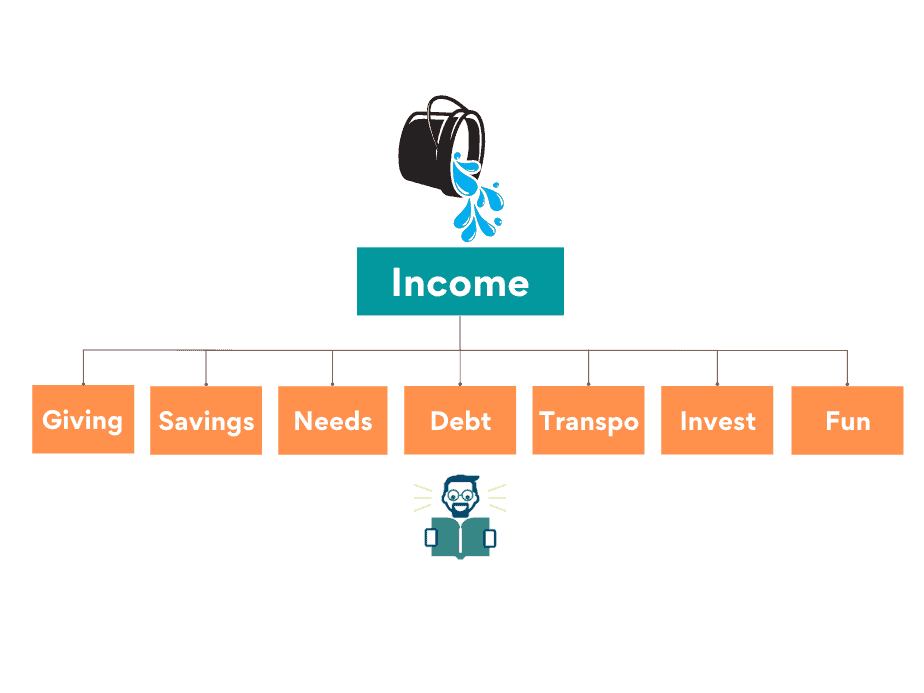
There are several ways to manage your finances. But what works best for me by far is the zero-based budgeting technique I learned from Dave Ramsey. The goal is to allocate your income to smaller funds until it reaches zero. Every dollar (or peso) should have a purpose. I simplified this approach by allocating a percentage based on priorities. Here is an example:

Income$1,000
Less
Giving (10%)$100
Saving (10%)$100
Necessities (30%)$300
Debt payments (15%)$150
Transportation (10%)$100
Business/Investment (15%)$150
Fun/Travel/Entertainment (10%)$100
Total$0
A table that shows Jed’s approach to zero-based budgeting.

Having this kind of system allows me to not let my emotions decide on what to do with my money. Whether it is $100, $1,000, or even $1,000,000, they are all going to be allocated the same way. This is how I have managed my money since 2017. There have been a few tweaks here and there, but the overall approach hasn’t changed. This is my simple and repeatable budgeting system. And this is also the system that helped me and my wife pay off eight credit cards.

Zero-based budgeting system
An illustration of Jed’s version of the zero-based budgeting system.

What will happen if the budget is not met?

Not meeting your budget may result in guilt, frustration, and losing control of your finances. Worse, it may even become a habit that can lead to unwanted debts and graver financial repercussions. A budget is an essential part of personal finance. Without it, you will be putting your financial health at risk.

But don’t fret. The good news is, budgeting is a highly learnable skill. If you find yourself constantly struggling to meet your budget, perhaps you can start with something basic. Like the 80/20 approach. Save 20 percent, and spend the rest. Keep this discipline for now, then level up to 70/30, when you get better at meeting your budget. And then to 60/40. There will come a time when budgeting becomes second nature, and you will be able to make a more complex allocation such as 50/30/20. 50% needs; 30% wants; 20% savings.

Closing thoughts

A budget tells us what we cannot afford, but it doesn’t keep us from buying it.
William Feather

Nonetheless, whatever your approach is, the bottom line is you have to partner it with the right behavior. Personal finance is personal. As William Feather says, “A budget tells us what we cannot afford, but it doesn’t keep us from buying it.” Here are some questions you can ask yourself when you are having a hard time meeting your budget; or in managing your finances overall:

  • Am I saying yes too often?
  • Do I have an accountability partner?
  • Am I holding on to things I no longer need?
  • Do I have more than one credit card?
  • Am I committed to my budget?
  • What are the factors preventing me from meeting my budget?
  • What is one thing I need to improve on to better manage my finances today?

See also


Follow the Journey

This journal is my way of making sense of the lessons from the journey. Get the next full entry delivered straight to your inbox.