How Can Family Life Impact Work?

It is not a mystery. Everyone knows there is tension between family life and work. They are both important aspects of life, and both also impact one another directly. It’s like trying to look at your left and your right at the same time. If you say yes to family, you are in a way saying no to some areas of your career; and vice-versa.

Studies have shown that family life generally has negative effects on work. Based on surveys, working parents say their careers are either being slowed down or worse, interrupted because of their responsibilities at home. Children are considered to be the biggest roadblock to career advancement.

Read on to learn how family life can impact your work. This post contains research data from trusted sources to give you an objective outlook on this matter. Overall, this article serves as informational material only. It does not, by any means, intend to give any professional advice.

husband and wife coffee selfie
My wife and I are having breakfast by the pool.

5 ways family can affect work

I gathered some data, so we can have a more tangible idea about the effects of family on work. Here are the results of the study conducted by the Pew Research Center on this matter.
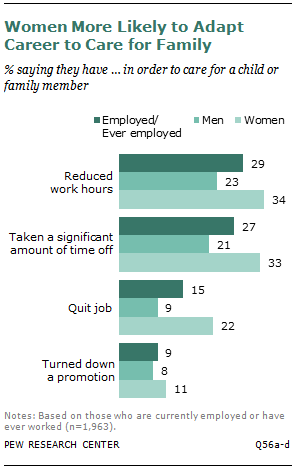
A survey by the Pew Research Center showed how men and women adjusted to their careers to give way to family life.
  1. Reduces your work hours.
    In total, 29% of adults in the workforce said in a survey that they have reduced their work hours to care for their families. Based on the data, women are more likely to do this. 34% of women stated they have cut back on their working hours, while only 23% of men said the same thing.
  1. Make you take a significant amount of time off.
    27% said they took a significant amount of time off from work, at some point in their career, in place of family. There is a similar gender gap on this matter: 33% of women, versus 21% of men, said family life has affected their work this way.
  1. It can cause you to quit your job.
    Overall, 15% said they had to quit a job for their families. Again, men are less likely to have done this: 22% of women and 9% of men report having to quit a job for family reasons.
  1. It could stir you to turn down a promotion.
    Approximately one-in-ten working adults (9%) say they have turned down a promotion, so they can take care of their child, or other family members. For this part, men and women almost share equally. Women, 11%. Men, 8%.
  1. Harder to advance in career.
    Referring to the data below, 27% of parents said that family has made it harder for them to advance in their careers; while only 7% said this has made things easier. There is a significant disparity between mothers and fathers here. 40% of mothers said raising their children made it difficult for them to progress in their jobs. While only 15% of fathers said the same.

    Among moms whose kids are under age 18, 51% said motherhood makes it harder for them to advance in their careers (only 16% for fathers). Yet, as a whole, mothers with grown-up children are less likely to say parenting has made it harder for them to get ahead at work.
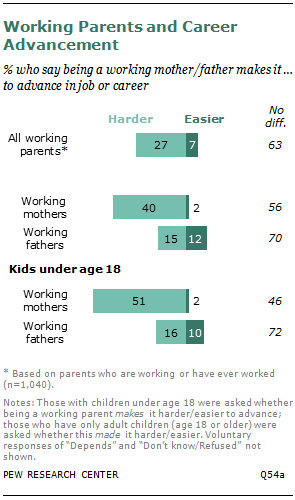
Data by the Pew Research Center on how family life made it harder for parents to advance in their careers.

Family issues and work-life balance

Both family and work-life require time and involvement. Since no human can be in two places at the same time, this would cause irreconcilable pressure between them — also known as work-family conflict. Here is a report by the European Agency for Safety and Health at Work about the prevalence of work-family conflict in the EU; which is also seen in the whole world:

  • 27% of workers in the EU perceived they spent too much time at work;
  • 28% felt they spent too little time with their families;
  • 36 % felt they did not have enough time for friends and other social contacts;
  • 51% believed they did not have enough time for their own hobbies and interests.

Most people try to resolve this matter through what is called work-life balance. But many have seen the inefficiency of this approach, thus they opt for a “smarter” tactic: staying unmarried, or marrying later in life. According to an article by the Pew Research Center, only 30% of Millennials have a family of their own — that is, living with a spouse and a child. This makes them the least likely to have a family before the age of 40 compared to the previous generations:
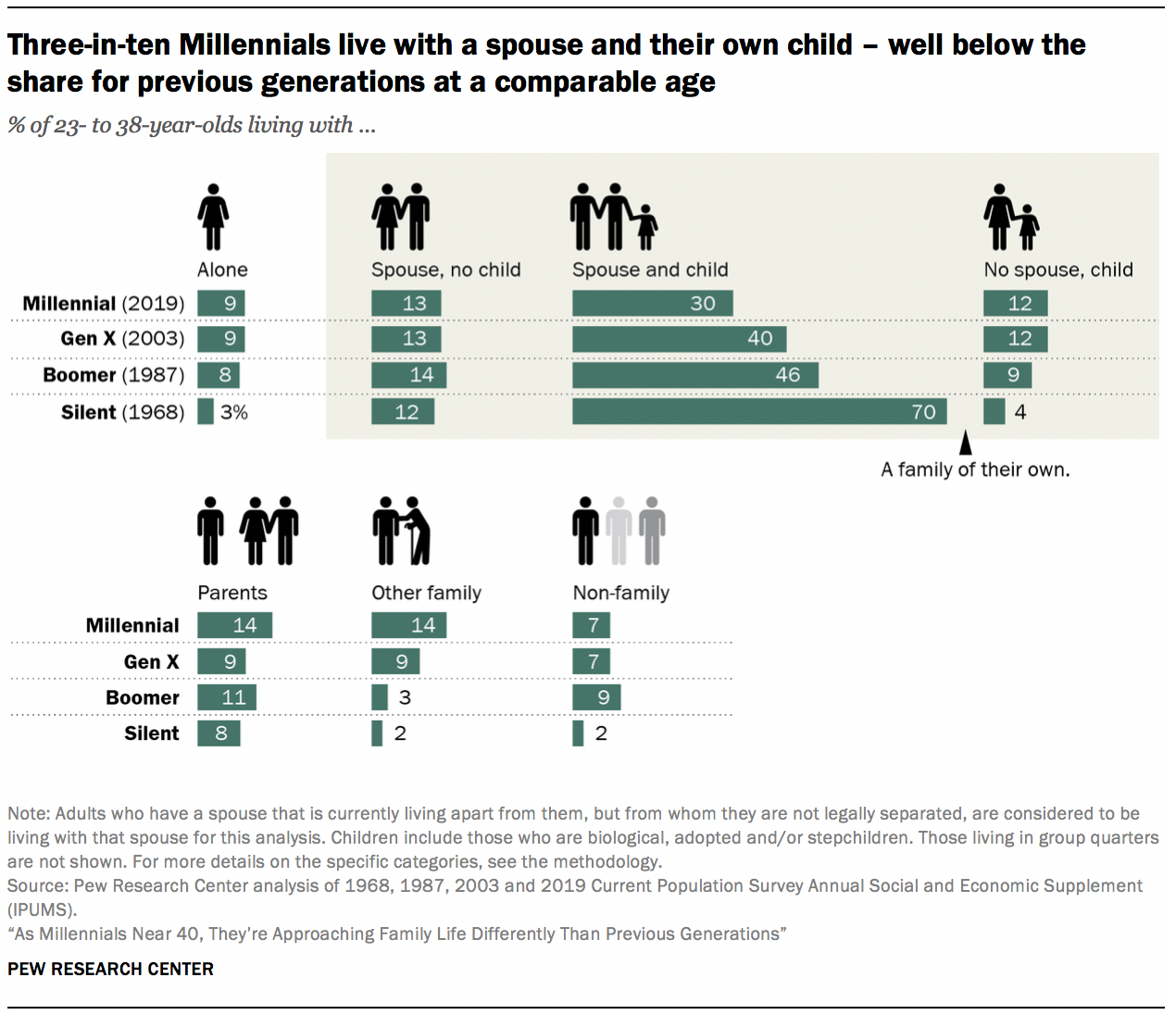
An infographic by the Pew Research Center on the percentage of people aged 23 to 38 living with their families.

Business Insider said millennials tend to marry later because they take their time to get to know their partner, grow their assets, and give priority to becoming financially successful.

Is it ok not to marry?

It is fine to remain unmarried if that is what you desire. Many people enjoy their singleness. What is not okay, however, is when you choose not to have a family due to purely economic reasons. While many deem family life as a hindrance to their careers, study shows it actually complements wealth building.

It’s only practical for people to consider the financial aspect of their decisions, a lecturer at Bentley University says.

“The economy shapes the choices people make about whether or not to get married. During the Depression many people didn’t get married or postponed marriage because it was not financially viable and there weren’t enough men who had the money to feel like they could provide for a family.”

— Clarissa Sawyer, Teacher of Gender Psychology and Adult Development and Aging at Bentley University.

We have already seen how family life can slow down your career. But here is the plot twist. It also has the potential to boost you financially. Below is a statement by Bentley’s senior lecturer in law and taxation, Steve Weisman:

“To me, there are so many things that encourage people to marry for financial reasons… from social security to income taxes, married couples benefit economically.”  

Thomas J. Stanley (1944 – 2015) spent most of his career studying millionaires. In his book, The Millionaire Mind, he presented a demographic sketch of what the rich look like. This is based on the average results he collected from surveying approximately a thousand self-made millionaires. There’s a lot, so I will only list down what applies in the context of family life:

  • I am a 54-year-old male. I have been married to the same woman for 28 years. One in four of us has been with the same spouse for thirty-eight or more years.
  • On average, we have 3 children.
  • 92% of us are married. And of those married, 95% have children.
  • Only 2% of us have never been married. About 3% are widowed.
  • Most of us believe having a family complements, not competes, with the process of building wealth.
  • We live in fine homes in quality neighborhoods, but only 2% of us inherited all or any part of our homes and property.
  • Some of us have inherited a portion of our wealth. Nearly 8% inherited 50% or more of their net worth. In sharp contrast, 61% of us never received any inheritance, financial gifts, or income from an estate or trust.
  • 97% of us are homeowners.
  • 32% of us are business owners or entrepreneurs.
  • Nearly 50% of our wives do not work outside the home. 16% who were employed outside the home are currently retired.
  • We are not workaholics, and we spend a lot of time socializing with friends and family. When we work, we work hard. We focus our energy to maximize the return on our efforts.
  • We believe having a supportive spouse is one of the top success factors.

What do you think? In essence, the premise of the survey about marriage and financial success is that you have to choose your spouse wisely. Two heads are always better than one. More than love and physical attraction, having a spouse who is frugal and has good business sense will have a healthy impact on your career.

Let me wrap this up with an excerpt from an article in the Boston Globe:

It’s not only the legal benefits of marriage — such as better tax treatment, visitation rights, and inheritance. Marriage is also a shield against poverty; the married are economically more secure (even when it comes to divorce). Then too — and of great consequence — children thrive better when raised in stable households.

— Tom Keane, Globe Columnist, July 27, 2014

Closing thoughts

There are always two sides to a coin. How can we connect the two seemingly contradicting studies about the impact of family life on work? Here is my key takeaway:

  • Don’t make money the number one driving force for making life decisions.
    Family life and work will always have tension. But choosing to have a family or not shouldn’t be treated entirely as a financial move. At the end of the day, whether you decide to pursue a lifelong career or settle down to a family-centered life, you will be better off picking the one that gives you meaning. As a follower of Christ, I believe God will ultimately supply our needs whichever path we choose.

See also

Sources


Follow the Journey

This journal is my way of making sense of the lessons from the journey. Get the next full entry delivered straight to your inbox.

How To Make Family Life Easier (Dad version)

Family life will never be easy. But it is possible to make it easier than it should be. I have read a bunch of articles on how to make life at home less grueling. They were insightful and well-written. My only sentiment, however, is all of them were from a mother’s point of view. I have nothing against you mommies, I love you and have learned so much from you all. It would just be nice to get some insights from the dads as well.

Nonetheless, that is what compelled me to write this post. I intend to contribute to the conversation through the lenses of a father. Read on to learn the strategies I use to make my family life easier.

1. Decide in advance

Pre-deciding will make your family life flow smoothly. It is a practice of setting up the ground rules or principles — so you do not have to actively decide every time. It lessens decision fatigue, and concurrently, allows everyone in the family to be on the same page. Deciding in advance will make every member capable of making sound choices that are beneficial to all. Below is a list of examples of how we pre-decide as a family:

  • Define family priorities.
    It’s Sunday, where should you go first?
    a.) to church
    b.) to parent’s house
    c.) to the shopping mall

    Believe it or not, simple questions like this can spark conflicts among family members. Defining your family’s priority is the most vital element in pre-decision. We are humans. Our time is limited, and we cannot be in multiple places at once. Clarifying what is important — and determining their order — will give us better control over our commitments.

    As for me and my wife, here is the order of priorities we have agreed upon:

    #1: Faith in God.
    #2: Relationships with family and friends.
    #3: Keeping ourselves healthy.
    #4: Personal growth and development.
    #5: Work and volunteer activities.


    Because we have already established these priorities, my wife and I will more or less have the same answer to the question above, even if we did not talk about it. It was already pre-decided that we would go to church first, then have lunch with our parents, and go to the mall to enjoy some family time afterwards.
  • Keep a family calendar.
    One of our family principles is to let your yes be “yes,” and your no be “no.” We seldom say “maybe” or “we’ll see” whenever we received an invitation. We do this for two reasons. First, it is a sign of respect. We do not want to leave any person hanging. Second, making a decision right there and then saves us time and declutters our schedule. I personally cannot relate to those people who delight in being followed up over and over again.

    We, in general, only say yes to our priorities, and when the schedule is free. Lalaine and I manage our family calendar religiously. We have set up a Google Calendar where we can get a bird’s eye view of each other’s agendas. This discipline helps pre-decide when to say yes and when to say no. As a result, many conflicts between us have been prevented.
  • Discuss what-if scenarios.
    My wife is a member of several mommy groups on Facebook. She has a habit of sharing with me the family issues she frequently reads on her news feed. These small talks eventually grew and became a regular brainstorming session with her. It is now a significant part of our marriage where we discuss matters and come up with a battle plan as if we were in a similar situation. This allows us to challenge each other’s thoughts and have a more synchronized approach to family life.

    One of the concerns we tackled recently was about mother-in-law (MIL) relationships. Apparently, many wives feel like they are competing with their MIL for their husband’s love and attention; that they give more priority to their moms over their wives. Thankfully, we do not have this kind of issue in our marriage. But discussing what-if scenarios spurs us out of complacency, and pre-decide on solutions to impede such concerns.

    To avoid this type of conflict, Lalaine and I agreed on the following order of relationship within our family:

    The spouse always comes first.
    Children second;
    parents third;
    siblings fourth;
    other relatives fifth;
    and friends will, in general, have the least priority.


    So, if I was put in a situation where I had to choose between my wife and my mom (or even my children), I would always choose my wife. I have already informed everyone in our family about this pre-decision, thus no one takes offense when they have the lesser priority. I also expect them to do the same to me. This structure will, of course, change in case of emergencies.

2. Train your children

Family life will be a hundred times more challenging when you become a parent. But this is especially true when you try to do everything for your children. I do not mean to sound disrespectful, but many parents nowadays treat their kids as pets rather than apprentices. I don’t know what your parenting style is, but if you want to have an easier family life, start training your children to be independent. Besides, being the life coach of our kids is one of our responsibilities as fathers. See the 10 responsibilities of a father I learned in training here.

  • Teach children to take care of themselves.
    I cringed when I saw a five-year-old getting his teeth brushed by his mom while playing video games on one of our outings. A fifteen-year-old having his nails clipped by his dad. An eighteen-year-old who needed help from someone to slice his steak. A twenty-nine-year-old who didn’t know how to peel boiled eggs (true story).

    As a parent, I can relate. There are legitimate reasons why we spoon-feed our children:

    — for things to get done quicker
    — to avoid the mess
    — to remove the risk of them getting hurt.

    But for how long should we do all these things for them? Ironically, too much service will do us and our kids a disservice. They will grow up overly dependent, which would stunt their confidence in doing matters on their own. It is no wonder many parents are so burned out today. Rather than always covering up for them, let us teach them how to be self-sustaining instead. We will not always be around for our kids. But knowing they are capable of taking care of themselves will give us peace of mind.
  • Develop their sense of responsibility.
    One of the ways we train our children, which has improved our family life, is through taking responsibility. We constantly remind them that it is okay to mess up, as long as you clean them up. When they spill their milk, instead of getting mad, we simply tell them to get the towel and wipe it dry. When they clutter their room with toys, we just tell them to pack up after they are done playing.

    My kids are four and two years old (as of this writing). I don’t expect them to be exceptional at taking responsibility yet. The way they tidy up is, of course, mediocre. But since they have experienced the consequences of their actions, they have become more careful about creating disasters. Essentially, aside from being able to instill good values, this practice also saved us a considerable amount of time and energy on keeping up with their mess. Not to mention, the heartaches and headaches of having a chaotic house.
Jrue love noodles. Both our children know how to eat by themselves with minimal supervision.

3. Learn to use technology effectively

We haven’t hired a house helper ever since Lalaine and I moved out of our parent’s house — see our story on leave and cleave here. Though we occasionally pay someone to clean our home for half a day, we have never employed anyone long term. Our objective was to develop our husband-and-wife tandem. But the more compelling reason is that we do not want to get caught up with the personal issues most house helpers have. It is a mess we by no means wish to be part of. Therefore, where we have put our money instead is in technology.

  • Set and forget.
    Set-and-forget is a term used for devices that can be configured to operate on their own. My wife and I are chumps for these types of machines because they make our family life incredibly easier. We will spend about fifteen minutes setting them up, and then come back when the job is done. In a sense, we can cook, do the laundry, wash the dishes and feed the cats all at the same time while writing this blog post or homeschooling the kids.

    Here are the set-and-forget appliances we currently own:

    — Ovens
    — Air fryer
    — Pressure cooker
    — Washing machine
    — Dishwasher
    — Coffee maker
    — UV sterilizer and disinfection system
    — Automatic pet feeder
    — Smart plugs (to program our appliance’s operating schedule, and make them accessible via internet.)

    Set-and-forget is also a strategy I apply in my business. I use tools such as Social Champ and SendFox to automate my social media postings and email newsletters.

4. Embrace the mess

Who likes mess? Not me for sure. But that is an understatement. Seeing our house in disarray is actually one of my trigger points. It’s what initially made me regret having children. It’s what I hate about parenting (see story here). It’s what my wife and I fight about most of the time. Our family life only began to get better when I learned to embrace the mess. I have acknowledged it as a cost of having children; that it is only a phase me and my wife have to go through.

  • Practice wu wei and wabi-sabi.
    Wu wei is a Chinese word for the art of non-action. It is a discipline where you intentionally go with the flow rather than swimming against it. Wabi-sabi, on the other hand, is a Japanese philosophy of seeing beauty in imperfection. It is the perspective of accepting and appreciating the flow instead of complaining about it. Combining these two principles is pretty powerful. It enabled me to experience peace, joy, and contentment amidst the turmoil.

    I always have the urge to fix things when something is not right. Thus, I am compelled to tidy up whenever I see any clutter — and will not stop until it is perfectly clean. This drive, more often than not, brews conflict in our house, especially when I am already tired at night. “After working all day, you expect me to clean all this mess?!” Wu wei tells me I don’t have to. While wabi-sabi encourages me to enjoy this moment of imperfection.

    So does that mean I no longer clean the house? Absolutely not! But I only do it for about ten to fifteen minutes each morning. I simply cover what I can during the allotted time and be at peace with whatever I cannot throughout the day. I am starting to get the hang of it. Who knows, maybe when the kids are all grown up I’ll miss the feel of a messy apartment.
  • Set up a mess box.
    Another strategy to keep our home a bit tidy without giving too much effort is by setting up a mess box (or corner). It is a place where we can just dump everything there, and organize when we have the time. Determining a mess area is a quick way to declutter the place. It will also make stuff easier to find. If my kids look for their toys, or my wife for her charger, I simply tell them to check the mess box.
mess box
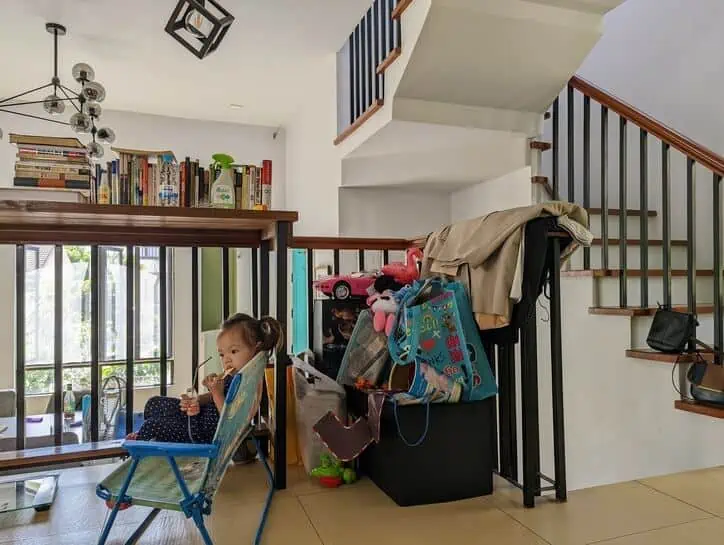
Here is an image of our mess box/corner.

5. Simplify

Keeping up with stuff can make or break your family life. The size of your house. The number of cars you have. The pieces of clothing in your closet. The more possessions you own, the more time, money, and energy you need to maintain them. If you want to have an easier family life, you should simplify your lifestyle by minding the belongings you invite to your home.

  • Downsize.
    One of the verses in the Scripture we live by is found in Ecclesiastes 4:6. It says, “Better one handful with tranquility than two handfuls with toil and chasing after the wind.” It has been our practice to focus more on elimination than accumulation. In terms of clothing, for example, I have set for myself a maximum of ten tops and ten bottoms. Anything more will be put in our donation box. It is also the same approach with food. Whatever does not fit in our fridge should be eaten or given away.
  • Live within your means.
    Another way to simplify your life is to pay only in cash. Paying in cash, sort of, guarantees you are only spending what you have. You can also use a debit card if you prefer, since it also settles payments like cash. But avoid credit cards or acquiring loans at all costs — if you are unsure how to use them. One sure-fire way to mess up your family life is by getting into unnecessary debts. Debts can lead you and your family to different levels of physical, mental, emotional, and relational strains. See how we conquered our debt problems here.

6. Synergize work and family life

Work-life balance is a myth. It’s like searching for seven orbs, so you can summon a dragon who can magically give you an awesome family life. But even if you did find the mythical creature, it would require great effort to keep it. You will continuously feel the tension between work life and family life — which could one day rip you apart. It is like being in a tug-o-war, where you are the rope.

Work and family life can be so much fun when you synergize them instead. Synergy means to combine or operate together. It is like being married. Like hitting two birds with one stone, or blending milk and strawberries together to make a delicious smoothie.

  • Work at home.
    Unless you work at home (or bring your family to work) I am not sure of other ways to synergize your professional and personal life. Lalaine and I had planned this set up long before we decided to have children. Of course, there is a cost for working at home (story here), but it is a cost we are willing to pay to be more present in our children’s lives.

    Here are some ideas to make money at home:
    — Start an e-commerce business. (Check out SpreadSimple)
    — Host your unused spaces on Airbnb.
    — Be a content creator. (Check out Income School)

    I run a blog and an e-commerce site. One way we bond as a family is I would bring everyone with me whenever I deliver to clients. After I finished working, we would go to the nearest mall and spend the rest of the day there. It is one of the priceless benefits of being able to synergize home and work life. See also: How much do stay-at-home dads make? — My Actual Numbers
  • Homeschool.
    This is the area where we will wait and see. Based on my research, homeschooling isn’t for everyone. It will greatly depend on what the child needs, and the capacity of the parents to teach. It has been a year since our eldest started homeschool — so far so good. Kudos to my wife for doing a great job. We hope and pray this continues. If not, then we have no issues enrolling them in traditional schools. Giving what is best to my kids trumps work-life synergy.
The perk of work-life synergy: being able to eat out with your family whenever you crave for xiao long bao!

7. Mind your relationships

I wish I could extend this post further. I still have a lot to give you. But I would also like to respect your time. So here is the final and most crucial tip before I close: mind your relationships. Rifts in relationships are generally the ones that make family life difficult. It can stem from mistrust, baggage from the past, or other toxic relationships we are in.

  • Forgive and repent.
    We are all flawed people. Yet when it comes to forgiving and asking for forgiveness, we act as if we are impeccable. That is why “I am sorry” and “I forgive you” are among the hardest words to say. Forgiveness and repentance are muscles we should train if we desire to have healthy relationships. No matter what we do, we will offend or get offended by the people we love. Keeping records of each other’s mistakes will only make our family life messy. Try forgiving someone today and see how it transforms your relationships.
  • Choose whom your family associates with.
    My wife and I do not shy away from cutting off unhealthy relationships. Pruning toxic people and creating healthy boundaries within our circle is a practice we do regularly. We take inventory and invest in relationships that will help our family mature. We have planted ourselves in a community where we can be active and fellowship with. It is so much better to have a few quality friends than a lot of people who can bring harm to the family.
  • Live with integrity
    I saved the best for last. The fastest way to make your family life easier, is by always telling the truth. No need to think of an alibi or excuses. No need to fake it. No need to build on a lie, after lie, after lie. If you have been living a double life, all you have to do is come out, apologize, and start living a life of integrity. You won’t appreciate how wonderful your life is until you start living with the truth. I know, because I have been there.

    Telling the truth also revolutionized how I do business. It has saved me from a lot of unnecessary stress. If the item out of stock, it’s out of stock. If my delivery time is 3-4 weeks, I tell my clients 3-4 weeks. I will not bend the truth just to make a sale; it is simply not worth it. I always lay down all my cards, and it is up to them if they will make a purchase or not.

    The truth will not only make your family life easier. But your life as a whole.

See also:


Follow the Journey

This journal is my way of making sense of the lessons from the journey. Get the next full entry delivered straight to your inbox.

What Do We Learn In A Family?

Home is where we learn the most crucial life lessons. As children, we are taught by our parents about discipline and proper manners. As parents, we develop virtues such as patience, prudence, and self-control in raising our kids. Being part of a family will constantly educate us, regardless of our age.

Togetherness is one of the major lessons we will learn in a family. Although each member is unique, we all operate as one unit. Every action we take as an individual can affect the whole family. We are collectively dependent on each other. Nothing great is ever achieved without the support of a family.

I am certain each of us has our own unique lessons learned at home. But togetherness, for me, encapsulates the essence of being in a family. It is a constant reminder that whatever I have achieved as an individual is in fact a result of my parents’ sacrifices. I mean, if it was not for them, I won’t be able to go to school — or be alive even. This thought will always keep me grounded. At the same time, togetherness also makes me think twice about what I am getting myself into. Good or bad, directly or indirectly, my behavior will forever have an impact on my parents, relatives, and children.

We all learn from our families differently due to the variety of our culture, beliefs, and traditions. The purpose of this article is to contribute to the conversation and share helpful insights about family life. Read on to discover some of the most meaningful lessons I have learned from my family.

Chan family picture
Mi familia.

What values do you learn from your family?

Our values determine how we live our lives. In essence, the right values lead us to the right path; while the wrong values lead us to the wrong path. It is therefore essential to assess the values we receive from our families. For it will not only influence our lives but also those of our children. Below are the things I learned from my parents, from being a parent, and from simply being a part of a family.

5 things I learned from my parents

While there are many things I learned from my parents, and family life in general, here are the most meaningful thus far:

  1. Just keep swimming.
    If I had to describe my parents in one word, it would be resilient. They have always been hard workers — not backing down on any challenges blocking their way. I have witnessed how people have disrespected them, taken advantage of them, and ridiculed them. But mom and dad simply shrugged them off and kept moving forward as a team.
  1. Consider others more than yourself.
    My parents are among the most selfless people I know. They always think about others more than they do about themselves. Though they struggle financially, my siblings and I didn’t experience dropping out of school or having an uncomfortable childhood ever. They also regularly volunteer for church activities, and have lodged homeless people in our house several times.
  1. Be your own boss.
    I got my entrepreneurial drive from them. My parents have been business owners as far as I can remember. This allows them to be flexible in spending time with us. They usually come home for lunch and go back to work after. Dad’s office was my favorite place to hang out when I was still a child.
  1. Do not be afraid to try new things.
    Mom and dad constantly encourage us to explore. They support our journey to self-discovery. When I was into basketball, they enrolled me in training camps. When I was into dogs, they bought them pet accessories. When I was courting Lalaine in high school, they gave me additional allowances to take her out or buy her gifts.
  1. Personal relationship with God comes first.
    I cannot imagine life without God. I have known Him because of my parents. Christianity will always be their greatest legacy in my life; and it is the same legacy I wish to pass on to my children. They enrolled us in a Christian school, so we could grow up in a community of Jesus followers. They have prioritized building our relationship with God more than anything else.
Young parents
A photo of my parents in their 30s (I think).

5 things I learned from being a parent

  1. Embrace the mess.
    Who doesn’t want a squeaky clean house? I do. It is one of the reasons I am often in a terrible mood when we have our children. Our home has become perpetually messy. What I have cleaned for an hour will only get dirty in ten minutes — and this has driven me crazy. As a result, my relationship with my wife and the children has been strained. I eventually learned to embrace the mess — knowing this is only a phase in parenthood. It is better to have a messy house than a messy relationship. Who knows, maybe one day when the kids have grown up, I will miss the chaos in my house.
  1. Cherish the moments.
    Every morning, when I wake up, I find myself checking my kids’ baby photos. Where has time gone? I reminisce about the moments when they were still in diapers crawling on the bed. The times when I have to bathe with them in the morning sun; and make them burp after they are fed. I have started journaling and become intentional in building moments with my family. I know there will come a day when I will want to look back at the person who they are today.
  1. How to express love in different ways.
    I always thought love is only expressed through gifts, time, hug, words, and being nice. But along the way, I understood loving is not as easy as it sounds. Love can also be expressed in service, in discipline, in sacrifices, and by being committed. As a parent, making myself healthy is also an act of love. The better I take care of myself, the better I can also take care of my family.
  1. It is often better to take flight before you fight.
    My default is to be reactive. When there is an issue, I want to solve it NOW. When my kids mess up, I want to punish them NOW. The problem with that approach is it rarely ends well. Typically, I either make the matter worse by messing it up more or hurting my children. One solution I found to be effective is to pause. I get out and walk around the house for ten to fifteen minutes. When I’m ready I come back and address the issue with a level head.
  1. Be mindful of your words, actions, and tone.
    Most people already know this: Children observe and copies. I regret the time when I raised my voice at my wife because we were having a heated discussion. Because later that day, I heard our son also did the same thing to her. I was shocked and apologized to both of them. Our kids are always watching. I learned to be mindful of everything I do from that moment on. Even the movies I watch, and the music I listen to.

5 things I learned from being in a family

I generally had a close relationship with my parents and siblings growing up. As far as I can remember, we started to experience friction in our family a few years after college; and somehow grew worse when I got married. The reason, perhaps, is because I am beginning to establish my own principles, priorities, and values — which can at times contrast with theirs.

Praise God my relationship with them was restored a couple of years after a major “incident”, a.k.a. fight. The word “restore” doesn’t actually best describe it since our relationship today has never been better. We now openly share our dreams, our plans, and our struggles with each other. I also find myself missing them whenever it is time to part ways. I do not actually have the words to explain everything. All we know was Lalaine and I simply prayed, and courageously applied these values in our relationship:

  1. Always do the right thing because it is the right thing to do.
    One of the biggest and most difficult step we ever took that fixed our relationship is moving out of my parents’ house. They initially thought we were evacuating because we resented them. But the reality is we are only following God’s call for husbands and wives to leave and cleave. It is an instruction for married couples to leave their father and mother, so they can be independent; and at the same time, be totally dependent on each other (Ephesians 5:31). Doing the right thing simply because it is the right thing to do is called integrity. If we can all behave as such in our own families, our relationships will flourish.
  1. You can still love one another even if you do not agree with each other.
    Of course, my parents were skeptical about our decision to leave and cleave at first. Even my siblings were trying to talk us out of it. I understood where they were coming from. They want our family to stay close and have each other’s backs no matter what. But Lalaine and I have already decided to pursue the path we believe is right. Fast-forward, they eventually saw the fruits of our actions. From then on we learned to respect each other’s decisions, and embraced the differences in our opinions. Because of this, God ultimately blessed us with a richer and deeper relationship with one another.
  1. Whenever possible, put everything on the table.
    Most seeds grow in the dark. Serious conflicts behave similarly. Confronting matters that can one day grow into something detrimental is healthy for a family. Being transparent is not an easy process, but it is a habit we must practice regularly. One of the constant issues we tackle in our family is debt. It is a painful topic for all of us to discuss because it brings back memories of failure and mistakes. Often, my dad and I get into heated exchanges with regard to this matter. But as a person who intends to free my family from this bondage, I must be brave to address it consistently. Every member should be aware of the gravity of the situation, the plan of action, and the consequences if ever we fail.
  1. Setup healthy boundaries.
    I got this from the book Boundaries by Dr. Henry Cloud and John Townsend. It is a concept that has transformed our family relationships. Setting up boundaries, in a sense, draws a clear line between you and your family. I know, it may sound more like a division than unity among family members. But the reality is, healthy boundaries protect the harmony of the family, and its structure.

    A quick example of this is priorities. We agreed not all relationships in the family are equal. To avoid unnecessary conflicts, we prioritized our relationships in this order: 1.) God 2.) Spouse 3.) Children 4.) Parents 5.) Siblings 6.) Other relatives. So let us suppose there is a conflict of schedule between my mom and my wife. Which event will I attend? Easily, I would go to my wife’s because she is a higher priority than my mom. This is, of course, in the context of a normal situation — not an emergency or a matter of life and death. By having this kind of boundary, it is easy for us to make decisions without anyone feeling offended.
  1. Love is not based on our emotions.
    If there is only one ingredient that made us love one another consistently, it is this: love as an act of obedience to God. It is a passage from Ephesians 5:21 that we are trying to apply in our family. It is love not based on feelings or how the other person behaves. It is loving our family members no matter what, out of our reverence for Christ. Sounds cheesy? A bit. But we cannot deny the impact this instruction has made not only on our families, but on every relationship we have.
My parents
A photo of my parents as of Dec 2021.

Closing thoughts

The bond that links your true family is not one of blood, but of respect and joy in each other’s life.
— Richard Bach

There is no perfect family. Conflicts will always be part of every household. It is a constant journey of learning how to love one another despite our disagreements. What’s nice, however, is that no matter what situation our family is in, we can always learn something valuable from each other.

See also

Sources

  • One flesh
    “Therefore a man shall leave his father and mother and hold fast to his wife, and the two shall become one flesh.” — Ephesians 5:31
  • Instructions for Christian Households.
    Submit to one another out of reverence for Christ. — Ephesians 5:21

Follow the Journey

This journal is my way of making sense of the lessons from the journey. Get the next full entry delivered straight to your inbox.