Is It Better To Start An Offline Business Online?

I’m into coffee these days, and I am peering for angles to turn this newfound passion into a business. The idea is cliché thus far: to open a coffee shop. But as I gaze from where I am now, the road going there won’t be a straight one.

There are major humps I have to take into account, like:

  • Competition — Is coffee still a viable business despite the huge players?
  • Experience — I only have a little knowledge and zero experience of running a coffee shop. All I have now is passion!
  • Capital — How much would it take to start a coffee business?
  • Unique Selling Proposition (USP) — What is so special about my coffee?

I would definitely have a high risk of failing if ever I decided to set up a coffee shop today. So here’s my plan: start the business online.

It is never a bad idea to start any business online. This allows us to set up quickly, test the market and validate our ideas with minimal risk. When we eventually open physical stores, our online efforts wouldn’t be wasted since they will complement our offline operations. And if the venture is not viable, we can easily pivot to another one in a few clicks.

To elaborate on this further, let us make a comparison of starting my coffee business online versus offline.

The differences between online and offline businesses

OnlineOffline
ProductCan focus one at a time.Need to develop multiple products at once.
PlaceWebsite and social media.Shopping mall.
PromotionDigital marketingDigital marketing + print ads
People1 to 2 employeesAt least 3 employees
PriceLowerHigher
Two Moka pots and a manual coffee grinder.

Product

  • Online: I can focus on one product at a time.
  • Offline: I have to come up with multiple products at once.

Developing products takes time and money. Starting my business online allows me to focus on one item first. To think out loud, I am planning to sell bottled lattes — as it is my favorite version of coffee. My wife and I have traveled a few hundred miles these past few months to explore the different kinds of brews we have in our country. We are trying to discover our ideal taste for a latte. So far, we have already come up with two kinds of recipes.

The same cannot be said about a physical coffee shop. It would be weird for a customer to come in and find there is only one item on the menu. A coffee shop usually has several choices of coffee and food.

Place

  • Online: Facebook page and a SpreadSimple e-commerce site.
  • Offline: Shopping mall

Here are the two places where I plan to sell my bottled lattes:

These two are my staple online distribution channels. A Facebook Page is essential for its chat function and a way to push fresh content. Most of the selling is usually done inside Messenger.

The SpreadSimple e-commerce site, on the other hand, serves as the main store where customers can look deeper at the products and settle their payments through debit or credit cards. SpreadSimple also has a backend where we can easily manage our product’s information and inventory.

To see a sample of these distribution channels, you can check out my Chromebook business’ Facebook Page and SpreadSimple e-commerce site.

Setting up these outlets would not take over a week and won’t cost me more than $100. As for the brewing station, I can use our home kitchen for that purpose. I have already bought a coffee grinder and a couple of Moka pots to make espressos. We will upgrade our equipment accordingly.

By contrast, a coffee shop in a shopping mall will take at least three months and cost more than $100,000 to build.

Promotion

  • Online: Search engine, social media, product sampling, ads.
  • Offline: Search engine, social media, product sampling, ads, print ads.

Aside from a Facebook page and an e-commerce site, a blog or a YouTube channel is another essential element in starting a business online. The main reason for this is to make our brand searchable and earn organic traffic. Furthermore, it will also allow us to build trust with our audience, which hopefully converts them into paying customers or followers.

Google loves to index high-quality pieces of content. So the plan is to produce a ton of helpful, search engine optimized, articles and videos which can direct visitors from our blogs/channels to our Facebook and SpreadSimple sites. Search engine optimization is a process I learned in Project 24 by Income School. It is by far one of the most effective and efficient ways to market our products today.

As for social media, I will simply stick with Facebook for now. If I have to add another channel, maybe Instagram or Pinterest. But those are optional.

I have also started sending out some samples of my brews to friends and families to get their feedback. Once I get the final recipe, I plan to jump-start the coffee business with Facebook and Google Ads.

As I ponder on it now, I do not think I will have a different marketing approach for a physical coffee shop. Aside from the mall foot traffic and directional signs, I would still utilize the power of the internet to promote my business.

People

  • Online: I can run it with my wife.
  • Offline: I have to hire a few employees.

The most beautiful thing I found in having a business online is I do not have to deal with employees — especially in today’s pandemic. Like our other online businesses, I am certain I can also run this planned start-up with only my wife by my side.

This won’t definitely be the case if ever I would start the business physically. My estimate is I would need to hire at least three employees to run the coffee shop efficiently.

Price

  • Online: I can price our products lower since there is not much overhead.
  • Offline: Higher price due to higher overhead costs.

One competitive advantage my wife’s jewelry business has over those who are more established is that it is 100% online. She can offer bigger diamonds at the same price as others because most of the value is spent on the stone, not on the store’s overhead cost. The same concept applies to this coffee business. I can offer better quality coffee at a similar price, or maybe even less than what a coffee shop offers.

Disadvantages of starting an offline business right away

Starting a business offline can expose you to a lot of disadvantages. A physical store costs more and is generally slower to start. It also has a limited reach and is harder to maintain compared to its online counterpart. Additionally, offline businesses are less likely to be able to transition to another venture if it fails.

The construction of our 361 Degrees sports boutique. October 2013.

Here is to expound on the disadvantages of starting a business offline:

Higher cost

Cash is the lifeline of any business. You lose the game once you run out of it. Unless you knew 100% what you were doing, you would be like playing for a hole-in-one if you had $100,000 and spent it on a physical shop. The business must succeed on the first try or else you will go back to working for other people or borrow their money to start a new one.

On the flip side, starting online with the same budget gives you an allowance to fail and try again up to a hundred times.

Slower to start

The process of opening a shop in a shopping mall is taxing.

  1. You need to submit a proposal, an application form, and business plan to the mall admin.
  2. Wait for a few weeks for them to review and approve the application. They will also check if there is a space available.
  3. Once approved, they will furnish you with their requirements and construction guidelines.
  4. You will spend about a week or more completing their requirements.
  5. Once complete, the admin will set up an orientation meeting with you and your architect to discuss their building policies.
  6. Start of construction.

Give or take, you can start serving your customers in three months.

For online, we can start selling and publishing posts in a week or less. What’s best is we can accomplish all that with our laptop at home.

Limited reach

A physical store relies on foot traffic. Based on research, the average number of visitors in a shopping mall per day is between 400 and 900. I rummaged through the old data of our sports boutique and learned we were getting about 150. And out of the 150 walk-ins, only 4 of them would make a purchase! No wonder our business did not survive.

Offline businesses cannot last on their own because of their limited reach. They need to tap on the power of the internet to promote themselves nationally, or even globally. Based on a report, more and more people now prefer to purchase online. Global e-commerce retail sales are projected to hit a new high of $4.9 trillion by the end of 2021. That’s a 256% growth rate from $1.3 trillion in 2014! Moreover, e-commerce sales are consistently chomping on the worldwide retail market. Purchases made online are expected to take up 17.5% of the total global retail sales by the end of the year. E-commerce is growing every day.

Harder to maintain

Our boutique’s monthly overhead cost is around $1,600. This includes rent, utilities, wages, and miscellaneous fees. Add to it the invisible expense called depreciation — which generally accounts for 15 to 20 percent per year.

Let us contrast it with our online business, which has virtually no overhead cost. Add to it the time and energy we need to spend on cleaning and maintaining the store itself.

Difficult to pivot

Here is the biggest disadvantage of an offline business: Flexibility.

According to statistics, only 3 in 10 start-ups will make it through the ten-year mark. What this means is there’s a 70% chance the business we are starting right now will not succeed.

I don’t mind failing, it is a part of the process. I went into the athletic wears business in 2012 and shut it down by 2016. I can deal with that. But what really finished me off was the fact that I could not reuse any of the assets I had invested in. The fixtures, the stocks, the systems. Everything has become useless. I have no other option except to start from scratch. I believe I would be far better off right now if there was a way to simply change the store’s signage and offer different products or services.

You can read my story on how I eventually transitioned my offline business to online here.

Anyway, the project that got me back on track in 2017 was my online bus transportation service. It provided well enough until Covid shut it down in 2020. I failed another business, but the difference this time is I was able to shift to another one using my current assets. I copied the system I had developed for the bus company and pasted it on the new venture. I was back in business in a couple of months.

Why start your online business right now?

Why not? Here are three reasons why you want to start your own online business today:

  1. Blogs and e-commerce sites generally take eight to twenty-four months to be profitable.
  2. Most of the learning involved in running an online business is done through trial and error.
  3. You are missing out on a lot of opportunities on the internet.

Coffee with a woman and a child.
Family bonding at Bag of Beans, Tagaytay, Philippines.

Closing Thoughts

This post by no means cancels offline businesses. As I mentioned earlier, my end goal is to open a coffee shop. There is nothing better than physically serving people and seeing them enjoy their coffee. But the thing is, I do not know whether I will be able to make it there or not. But starting this business online gives me a better fighting chance.


Check out these online classes that can help build a profitable online business:

Blogging and YouTube

Income School
Income School is an internet marketing company that teaches people how to create an internet business through blogging and creating YouTube Channels.  Income School is best known for its popular internet marketing and SEO channel on YouTube.

Freelancing and digital marketing

Learn by Fiverr
Learn from Fiverr is an online, on-demand video classes platform, specially tailored for freelancers and professionals. All classes are taught by top experts, who are distinguished in their fields.

See other recommended resources.


Keep In Touch


Thank you for reading!

Follow the Journey

This journal is my way of making sense of the lessons from the journey. Get the next full entry delivered straight to your inbox.

Things You Need To Start An Online Business (Cost breakdown)

Why do you want to start an online business? Here are the top five reasons, according to a survey:

  • “I wanted to be independent.” (49%)
  • “I wanted to have freedom and flexibility.” (43%)
  • “I wanted to have extra income.” (35%)
  • “I wanted to share my creative passion.” (33%)
  • “I saw an opportunity to fill a niche in the market.” (28%)
  • “I wanted to work from home.” (24%)

As for me, I wanted to work from home, I wanted freedom and flexibility, and I needed income.

It has been five years since I took the leap. I am now a full-time internet entrepreneur. There were many learning curves along the way, but I can’t be happier with my choice. Thank God for sustaining me and my family all these years.

Now it’s your turn. How serious are you about starting your own online business?

I heard this quote: The journey of a thousand miles begins with a single step.

And more often than not, the single step is about counting the cost.

The intention of this post is to help you with the initial step. I have compiled all the things you will need to effectively start an online business from scratch. Also included is the estimated price, divided into basic and advance. I hope this way, you can, more or less, gauge whether you are ready to take the plunge or not.

It will cost about $1,755 to buy all the basic things you need to start an online business from scratch. If you already have a laptop, a phone, a printer, and a decent internet connection, starting up may amount to as little as $470. Depending on how you wish to scale your business, you may need to add $500 to $1,000 to turn it into an enterprise.

The cost of starting an online business from scratch

Note:

These are all the general items you need to start an online business and their estimated cost. Prices will vary according to your location, suppliers, specifications, plans, and the types of business you wish to start up.

The cost breakdown is based on the assumption that you are starting your online business at home.

BasicAdvance
Total$1,755+ $434
Laptop$600
Smartphone$500
Internet$35 (monthly)
Initial inventory$400
Brand name$0
Email address$0
Logo$30
Homepage$0
Stock photos$0
Payment facilities$0
Delivery service$0
Packaging$40
Printer$150
Domain name$14 (Yearly)
Custom email address$0
Own website$100 (Yearly)
Email marketing service$0
Social media scheduler$120 (Yearly)
Cloud storage$0
Education$200 (Yearly)

Basic things you need to start an online business

These are the absolute musts if you want to start an internet-based company. Some of them are obvious, but I included them anyway, since our intention is to see the actual cost of starting a business.

Laptop

A computer is the most obvious item on our list since it is going to be the main driver of your online business. I cannot imagine running a company without this machine.

I chose a laptop since it is handy compared to desktops. Having a portable device will give you the power to access your business wherever you are.

As for the specs, my recommendation is at least an Intel Core i3 with 8 gigabytes of RAM, and 128 gigabytes of internal space. But I am not too concerned about the local capacity as there is always the option to expand it via external hard drive or cloud storage.

I also generally suggest picking up a Chromebook over a Windows-based laptop, or a Mac. 80 to 90 percent of the work is done online, and that is what Chrome OS specializes in. Furthermore, Chromebooks are fast, lightweight, secure, reliable, and are a lot cheaper compared to other laptops on the market.

If you are curious about what Chromebook I use, I am using an Acer Spin 713.

Check out other Chromebook models at Chromebook Store PH.

Smartphone

I am unsure if I even have to mention this device. Most people already have a smartphone, whether it is for business or not. But the reason I am mentioning it anyway is to expound on its role in online business:

  1. Building trust

More than chat or email, some customers want to call you to simply hear your voice. They want to ensure they are speaking to a real person.

  1. Customer service

There are matters, whether in sales or after-sales, best explained verbally.

  1. Mobile banking

Mobile banking allows you to send and receive payments online. They are generally better experienced via the phone app than in a browser.

If you want to read about mobile banking, follow the links below:

  1. Camera

You will most likely need your phone’s camera to create content such as product photos and social media posts.

  1. Security

Many sensitive online transactions now require an OTP or One Time Password to authenticate. These OTPs are mostly sent to your registered mobile number.

Features you need when buying a smartphone for your business

I only have a couple:

  • Good camera

You will need a good camera to create engaging online content.

  • Fingerprint sensor

I thought fingerprint sensors were only a gimmick, but I realized they’re really helpful for security and accessibility. I only appreciated it when my sensor gave up. It is now a pain to always type in my password whenever I access my mobile banks.

A dependable laptop and a smartphone are the two most expensive investments you will need in building your online empire.

Internet

You will need at least 25 to 50 Mbps to have a smooth online experience. In our country, that speed costs about $35 a month.

Initial inventory

This is optional depending on the type of online business you intend to start. I bought two units of laptops for about $600 as my initial inventory when I started Chromebook Store PH.

You may not need stocks if you plan to create a blog or a YouTube channel. But you might spend almost the same or more on equipment, software, education, and online infrastructure.

Brand name

A brand name is one of the vital elements of your online business. Take time to choose something catchy, easy to remember, and best describes what your company is all about.

My wife and I are not very good with names. So what we usually do is use a business name generator to gather ideas.

We would write ten names and cut it down to three. We then post them in group chats and ask people to vote for the one that resonates with them. Which name has the most votes is what we would often use as our brand name.

Email address

Besides a brand name, an email address is another significant component in your online business. Most, if not all, of your accounts on the internet need a registered email. As a start, you can use Gmail or Yahoo. But as your company grows, you will need a more professional email address.

Logo

I used to treat a logo as an optional part of a start-up. But now I see how essential it is. Having a logo gives your business an overall impression of sincerity and authenticity — not only to your audience but to you, as the owner, as well.

I do not know if it is just me. But I get fired up whenever I see the final design of my logo. It feels like everything you have planned is becoming a reality.

There are two ways to get a logo:

  1. Design your own with Canva.

If you are a creative person, you can make your own logo using Canva.

Canva is a web-based graphic design platform where you can create social media graphics, slides, posters, and other visual content using a browser.

You can start from scratch or choose from their ready-to-use templates — which I do not recommend as they are likely to be used by many people already. You want a logo that is uniquely yours.

Canva is forever free. But if you want to access their premium library and other features, they also have Canva Pro.

Try Canva Pro for free for 30 days.

  1. Hire a professional logo designer on Fiverr.

Since both my wife and I are not good at designing, we let the professionals do it. All of our logos are outsourced. Our usual go-to is Fiverr.

Fiverr is an online marketplace for freelance services. You can hire a professional logo designer for as low as $10, all the way up to more than $100. So far, we are getting decent logos for $30.

View the portfolios of Fiverr freelancers here.

Homepage

A homepage is a place where you want people to interact with you and your content. This can be a landing page, a channel, a blog, a social media profile, or an e-commerce site.

We always go for the free Facebook Page when starting up. But here are your other free options:

Landing page

Channel

  • YouTube
  • TikTok

Social media

  • Facebook
  • Instagram

Blog

  • WordPress.com
  • Blogger.com

E-commerce

Stock photos

As you build your homepage, you will need some nice photos to go with it.

You can get free good quality stock photos here:

  • Pexels.com
  • Pixabay.com
  • Unsplash.com

But I commonly discourage people from using free stock photos as your site and content may look generic. On the other hand, premium stock photos — which normally cost $10 per image — can be expensive for a starting business.

I solved this dilemma by purchasing a lifetime subscription to PicJumbo via StackSocial.

PicJumbo’s premium stock photo library.

But if you do not see the value of spending on stock photos, here is a hot tip to get them free:

Shutterstock gives away a premium image each week. All you have to do is visit their site and download it. Do this weekly, and you will eventually build your own library of high-quality stock photos.

Check out Shutterstock’s free image of this week.

Payment Facilities

You need a way to receive payments from your partners and customers. I generally use PayPal and Payoneer.

Here are other options, but I haven’t tried them yet:

  • Stripe.com
  • SquareUp.com
  • Wise.com

Delivery services

You have to plan on how you are going to deliver your products and services. Locally, we use Grab, Lalamove, and LBC to deliver physical goods; UPS for international. As for digital merchandise, I use an email service called Mailerlite for now.

Packaging

How you package your products is another major thing you have to consider. It should look nice and give good protection during transport.

For physical products, the usual are bubble wraps, eco-bags, paper bags, bottles, and boxes.

For digital products such as e-books, I use Canva and Designrr.

Printer

I rarely use a printer for my online businesses as most of my transactions are paperless. But there will be some customers who still like documents to be printed. This is more for emergency use as we cannot say when a customer will ask for a printed copy. Getting a basic printer will do.

Note: If you are getting a Chromebook as your main computer, please first check what printers are compatible with it. There are some models — especially the old ones — that do not run on Chrome OS or Google Cloud Print.

Advance list for growing your online business

These are the advanced things you can consider to make your business grow to another level.

Domain

A domain name is your unique business address on the web. It is the name people type in their browsers to visit your site. Having your own domain name will open your business to various online opportunities.

Many websites offer domain name registration. But the most cost-effective I have found so far is NameCheap. I love how they have already included domain privacy in their price — while others offer it as a separate add-on.

Domain privacy is a must when getting a domain. It hides your personal data from the world.

Custom emaill address

Once you have your own domain, you can already get your custom email address. Instead of having xyz@gmail.com, you will now have mail@xyz.com. People and companies tend to trust you more for having this kind of email address.

If you are planning to apply to an affiliate network or an email marketing service, you are more inclined to get approved if you have an email with your own domain name.

Having a custom email address usually costs about $1 a month. But you can get one account, free forever, with Zoho Mail.

Own Website

Other than having a custom email address, having a domain also allows you to put up your own website. It can be a blog or an online store. It’s up to you.

Having your own website gives you the advantage of scaling your business as well as having better control of your online company. You cannot rely on the free homepage forever as it makes your business dependent on another company’s success. When they go down, you go down with them.

It is okay as a start-up to use free services, but you have to put building your own sites in the pipeline. To be honest, all my business is still on a Facebook page. But I only use them as a supplement. I have already built a self-hosted WordPress blog with Bluehost, and an e-commerce site using SpreadSimple.

Learn more about building your own website here.

Email marketing service

More than 80% of marketers use email marketing. It remains one of the most reliable forms of connecting with your audience.

Here are the top 4 reasons:

  1. Less noise, more engagement.

Social media is like being at a party. Email is like inviting someone over a cup of coffee.

  1. You keep your own list.

When a person subscribes to your list, it is yours. It is not Facebook’s nor Google’s. You can keep the list and do whatever you see fit.

  1. Email will be around forever.

Email has been present since the beginning of the internet. And it is not going away anytime soon, or ever.

  1. Everyone on the internet has an email.

There are many things you cannot do online without an email address. So the chances are, all people who use the internet have at least one email account.

The price of an email marketing service varies depending on the number of your subscribers and how many emails you will send each month. As starters, we generally do not have to pay anything.

My two recommended email marketing platforms as of now are:

Free for 1,000 and below subscribers; up to 12,000 emails a month.

Free for 2,500 and below subscribers; up to 10,000 emails a month.

Social media scheduler

Social media marketing has become less and less effective due to the noise and its mysterious algorithms. In reality, there is only a small portion of our total audience who really sees what we are posting online. It’s like being in a wet market where everyone talks at the same time.

But being on social media still remains a crucial marketing strategy as most potential customers will check our profiles to validate our legitimacy. One of the vital aspects of our online presence is being up-to-date with our social media accounts. It is one way our customers will know we are still open for business.

There are two main strategies to counter the chaos in the social media realm:

  1. Posting at the right time.
  2. Repeating your posts.

According to statistics, the best time to post daily is around 10 am. And you should repost it about eight times to increase the chances of your followers seeing the post.

But who has time for that?

There are lots of other more important things to do in your business than just posting on social media. That is the reason why you need a scheduler.

I currently use Social Champ. But my other recommendation is Promo Republic.

Because of them, I was able to schedule all my posts one month in advance — at the right time, and at the right reposting interval.

Cloud storage

Many people would deem cloud storage as an optional tool. Yet, to me, it is one of my essentials. Cloud storage allows me to:

  • Back up my data securely online.

Having an online business means most of our assets are in digital form. What would happen to our files stored locally when our computers or hard drives get corrupted, stolen, or defective? It is a risk we cannot take as online entrepreneurs.

  • Be more productive.

With cloud storage, I can save the progress I made across all my devices. Furthermore, I can also work on another person’s laptop in case left mine at home.

  • Easily share files with your audience.

Selling or sharing your digital products is a breeze when using a cloud storage service. All you need to do is upload the files to the cloud and let your audience access them through a public link.

Here are the top 3 cloud storage I use:

  • Icedrive — (Free 10 GB)
  • pCloud — (Free 10 GB)
  • Google Drive — (Free 15 GB)

Education

As an entrepreneur, I cannot emphasize the need for continuous learning. The moment you grasp the kind of business you like to pursue, you must double down on it with knowledge. It will enable you to draw yourself a roadmap of what things you need to do to make your business successful.

Here are the recommended classes per category:

Content creation and digital marketing: Income School

Income School is an internet marketing company that teaches people how to create an internet business through blogging and creating YouTube Channels. Income School is best known for its popular internet marketing and SEO channel on YouTube.

Freelancing and e-commerce: Learn by Fiverr

Learn from Fiverr is an online, on-demand video classes platform, specially tailored for freelancers and professionals. All classes are taught by top experts, who are distinguished in their fields.

Getting a business degree: Coursera

Build skills with courses, certificates, and degrees online from world-class universities and companies.

General education: MasterClass

Whether it be in business and leadership, photography, cooking, writing, acting, music, sports, or more, MasterClass delivers a world-class online learning experience.

As for me, I have decided to get serious about blogging, so I enrolled in Income School last July 2021. And I have also been learning to write with MasterClass since 2020.

Closing thoughts

There will be more things to spend on as your business grows. You will eventually need to build a team and invest in a more advanced infrastructure such as a bookkeeping system and customer relationship management platform.

While all these tangible elements are essential in building a business, let us also not forget the intangibles — which are the underrated aspect of entrepreneurship.

Aside from the list we have talked about in this post so far, what you also need when starting an online business are creativity, courage, commitment, and patience. These are all free but are extremely difficult to acquire.


Sources:

Motivations For Starting A Business


Follow the Journey

This journal is my way of making sense of the lessons from the journey. Get the next full entry delivered straight to your inbox.

Why Is It Important To Learn Money? Here’s what the data says

Everyone deals with money daily. That alone establishes it as an incredibly important subject to learn. How a person manages his finances will not only have a serious impact on his life but the world around him as well. 

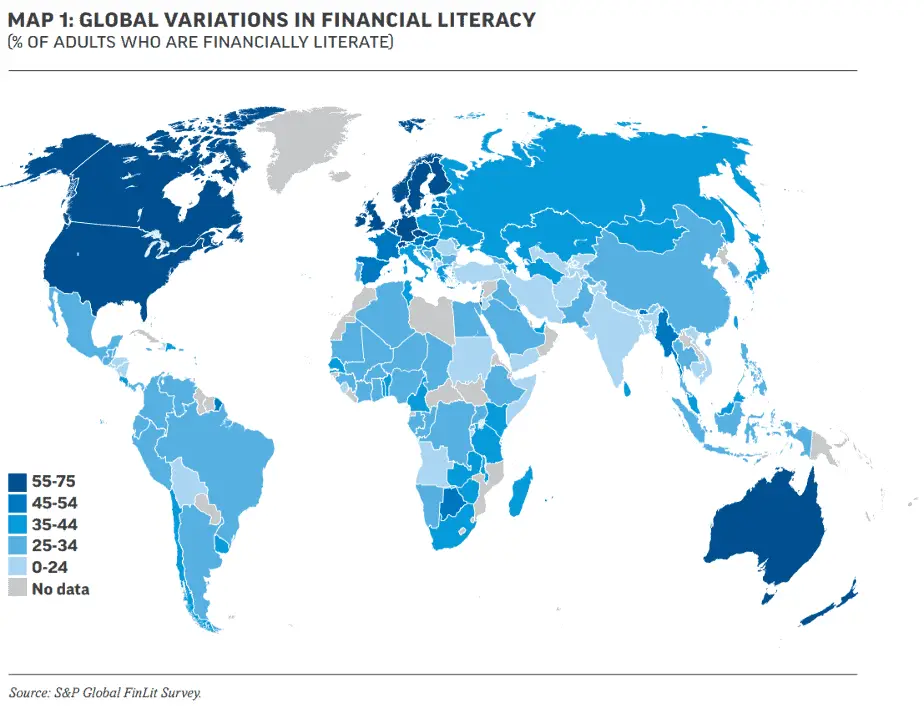
Yet, according to the S&P Global Financial Literacy Survey, only 1 in 3 adults worldwide understands money.

Map of Global Variations in Financial Literacy by S&P Global FinLit Survey.
1/3 of the adult respondents worldwide answered correctly to 3 out of 4 topics about finance.

I asked my four-year-old son why he thinks we should learn about money and this is what he said:

You must learn about money, so you can buy toys, clothes, and something to eat…like cake!

Joab

I guess most adults these days still see money as to how children see it: as a means to buy something.

But money is much more than that. The topic is so complex that even God talked twice as much about it as He did with regard to Faith and Prayer combined. The Bible has over 2,000 verses relating to money and possessions. He knows riches have a significant influence on a person’s life.

Most of us already have an idea about why it is important to learn money. But let us double down on it today with some science.

Here are six reasons why it is important to learn money according to data:

  1. Financial literacy results in higher net worth.
  2. Couples who discuss money enjoy better marriages.
  3. Economic growth is tied to high financial literacy.
  4. A low understanding of interest puts you at risk.
  5. Money-savvy people seize more opportunities.
  6. Most homeowners are financial literate.

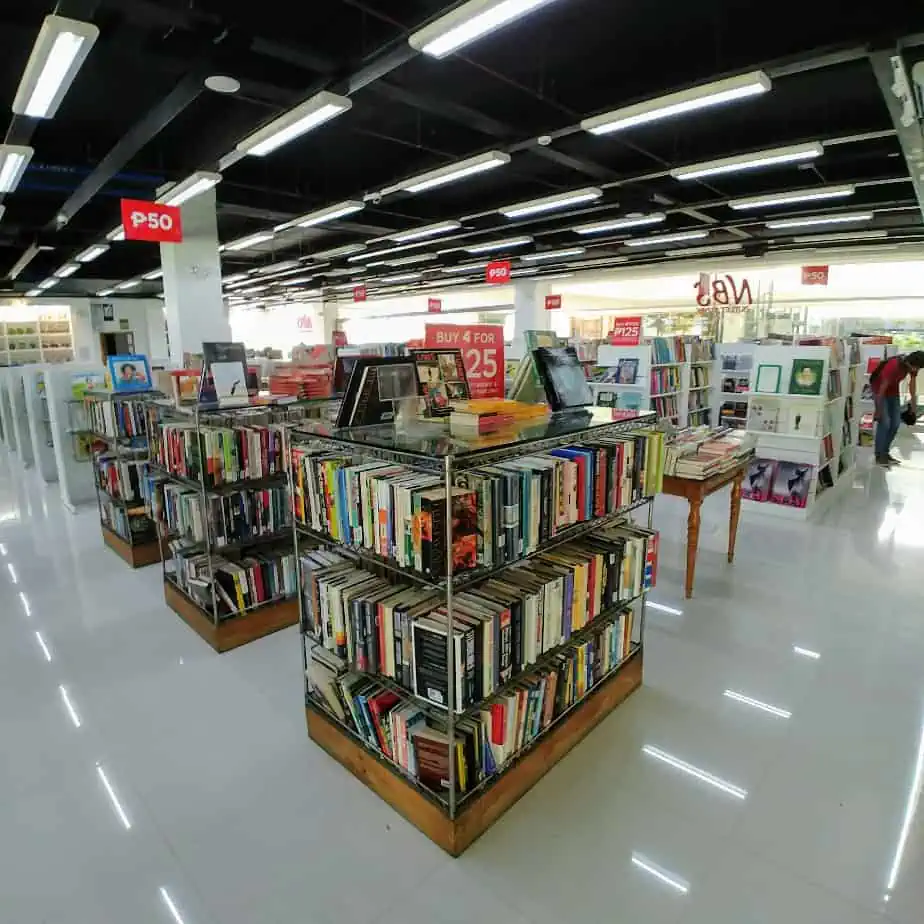
Bookshelves filled with discounted books.

1. Financial literacy results in higher net worth.

A survey conducted by Financial Capability Strategy For The UK with 13,054 respondents showed financial literacy has a positive and significant correlation with total net worth. Their study estimates a difference of 0.2 increase in the financial literacy score would, on average, raise net wealth by $13,800.

Why is this information vital? Simply put, learning about money makes you truly rich.

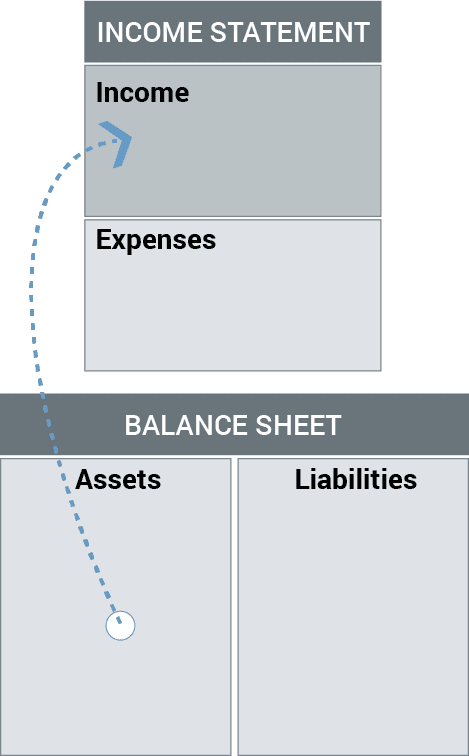
Net worth is the value of everything you own (assets) minus everything you owe (liabilities).

Most people see high-income earners as being wealthy. But that is not always the case. If a person makes $500,000 annually but spends $550,000, do you still consider him rich?

In his book, The Millionaire Next Door, Dr. Thomas J. Stanley differentiates these two types of people as:

  1. Income statement affluent
  2. Balance sheet affluent
Assets and Liabilities - Asset Cash Flow

Income statement affluent

These are individuals who have big incomes but little net worth. They usually live in large houses, drive luxury cars, but also deal with huge debts. These people work hard but play harder. As their income increases, so do their expenses and liabilities. They only see money as an instrument to get what they want. Thus, the more money they receive, the more toys they buy.

Many people are envious of the income statement affluent, thinking they are living “the life.” But if you take a closer look, what you will see are people who are actually living paycheck to paycheck. They do not have the means to support their lifestyle if their income gets cut off.

Balance sheet affluent

These are people who don’t necessarily have high incomes but have a high net worth. They live frugally and know how to invest their money to make it grow. This group puts a greater emphasis on simplifying their lifestyle, building their portfolio, and maintaining little to no consumer debts. Their assets always overpower their liabilities.

The balance sheet affluent is commonly invisible to the public. They are seen as ordinary people who wear plain white t-shirts and jeans. They are not flashy. Yet, if they are to stop working today, their investments can sustain them for many years to come.

To put it in a nutshell, having a high income does not make you wealthy unless you learn how to handle your money.

2. Couples who discuss money enjoy better marriages.

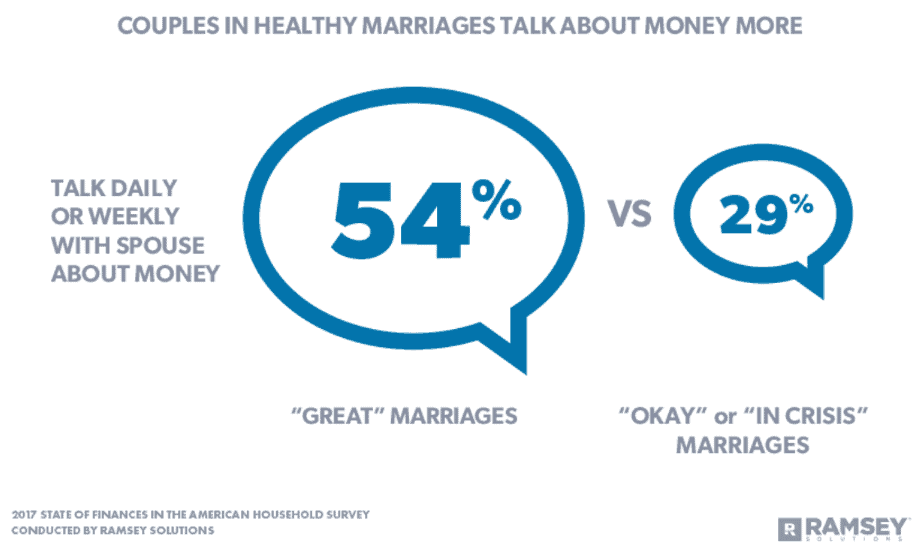
An infographic reveals that 54% of couples who discuss finances report having "great" marriages, while only 29% of couples who don't talk about money say their marriages are "okay" or "in crisis".

Infidelity is the leading cause of divorce. Do you know what is next? Money issues.

Wealth and relationships do not always go well, especially in marriage. There will always be tensions and disappointments attached to it. Why? It is because we all have different ideas and behaviors towards riches. Everyone has their own unique money mindset:

  • Some are savers, while others are spenders.
  • Some are comfortable living with debts, others do not.
  • Some are natural givers, while others are takers.
  • Some think it is better to invest in assets, while others think experience is the better investment.

And hundreds more reasons could spark a financially related argument inside a marriage. But what we can pick up from the data by Ramsey Solutions is these differences can be resolved by learning about money.

54% of married couples who discuss money say they are having “great” marriages; versus 29% who say their marriages are “okay” or “in crisis”.

Being financially literate in marriage is not only confined to knowing the overall concepts and theories about money. It also includes discovering and understanding our spouses’ views towards it. Differences in personality, background, preferences, and experiences are not the real root cause of money issues. The problem lies in communication.

So, if you find yourself in a toxic marriage due to financial concerns, ask your spouse to sit down and talk.

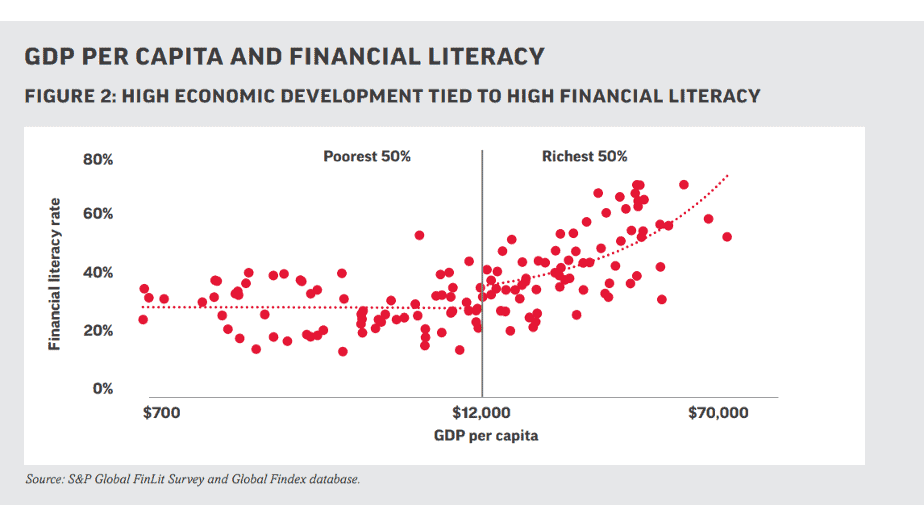
3. Economic growth is tied to high financial literacy.

A graph showing a high level of economic development is tied to high financial literacy.

Rich countries tend to have higher financial literacy scores based on the chart.

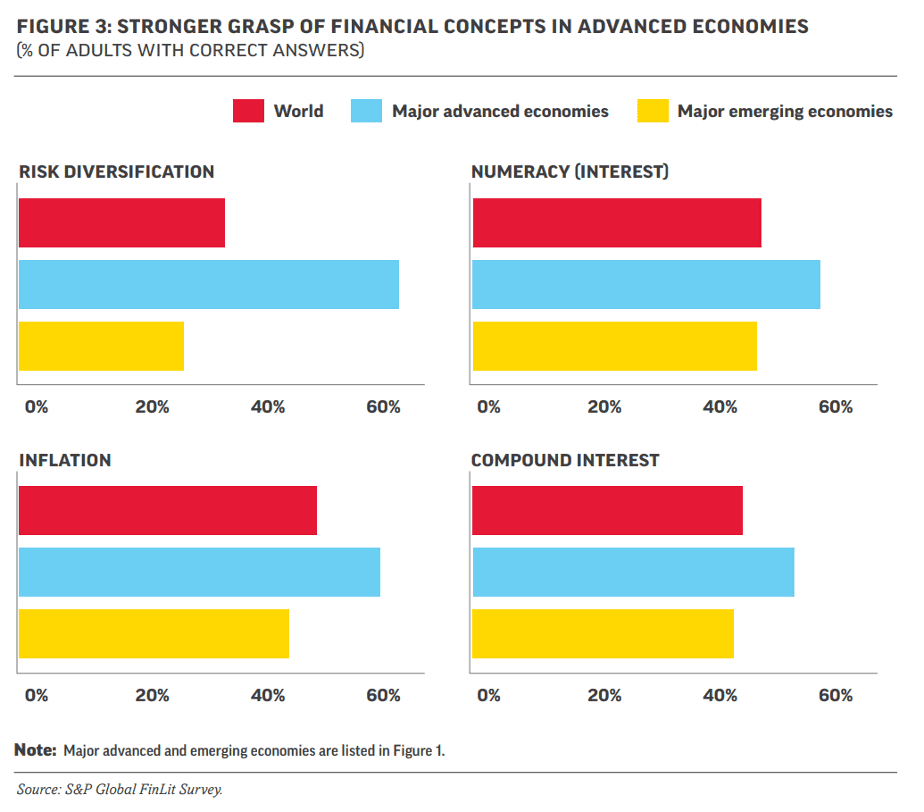
There are four main topics used to define financial literacy:

  1. Risk diversification

Is it safe to put your money into one investment or multiple investments?

  1. Inflation

If you buy something in ten years. Will it cost LESS, the SAME, or MORE than it costs today?

  1. Numeracy

You need to borrow $100. Which is the lower amount to pay back: $105 or $100 plus three percent?

  1. Compound Interest

Suppose your money is earning 15% interest per year. Do you make the SAME, MORE, or LESS amount in the second year compared to the first?

Here is another one.

Let’s say you have $100 and are earning 10% interest per year. How much money would you have in five years if you did not make any deposits and withdrawals from the account? MORE THAN, EXACTLY, or LESS THAN $150?

A chart showing a stronger grasp of financial concepts in advanced economies.

As you can see, countries with major advanced economies (rich countries) generally have a stronger grasp of these financial concepts.

Here are the 10 richest countries in the world (in GDP) and their financial literacy rating (as of Aug 2021)

Financial literacy benchmark:

Excellent71% and above
Good61% ~ 70%
Above average51% ~ 60%
Average41% ~ 50%
Below average31% ~ 40%
Low21% ~ 30%
Poor20% and less
CountryNominal GDP at $ billion% of adults who are financially literate
1United States20,807.2757%
2China15,222.1628%
3Japan4,910.5843%
4Germany3,780.5566%
5United Kingdom2,638.3067%
6India2,592.5827%
7France2,551.4552%
8Italy1,848.2237%
9Canada1,600.2668%
10South Korea1,586.7933%

6 out of 10 top wealthiest countries in the world have an average to good financial literacy rating. Yet, it is vital to note these countries listed above are only the richest in terms of GDP or Gross Domestic Product.

What this means is they are wealthy as a country, but the same cannot be said of their citizens — as GDP only measures the economic value of the country as a whole. To put it simply, GDP assesses the size of an entire pizza, but not how big the slice a person gets.

But there is another measurement to determine the living standard of the residents in a country. It is called GDP per capita. This is basically GDP but divided by the nation’s overall population.

GDP per capita determines the slice a person gets based on how big the pizza is.

A photo of the book *Master Your Money* by Ron Blue and Michael Blue.

Here are the 10 richest countries in the world (in GDP per capita) and their financial literacy rating (as of Nov 2021)

I’m surprised with how different the countries qualified on this list.

CountryGDP per capita% of adults who are financially literate
1Luxembourg120,962.253%
2Singapore101,936.759%
3Qatar93,851.7No data
4Ireland87,212.055%
5Switzerland70,276.657%
6United Arab Emirates69,957.638%
7Norway67,978.771%
8United States65,279.557%
9Brunei Darussalam64,724.1No data
10San Marino61,006.8No data

Again, 6 out of the 10 richest countries in the world as per GDP per capita showed a favorable literacy rate — with 3 having no data.

To sum this up, learning about money is not only good for us but the entire country as well.

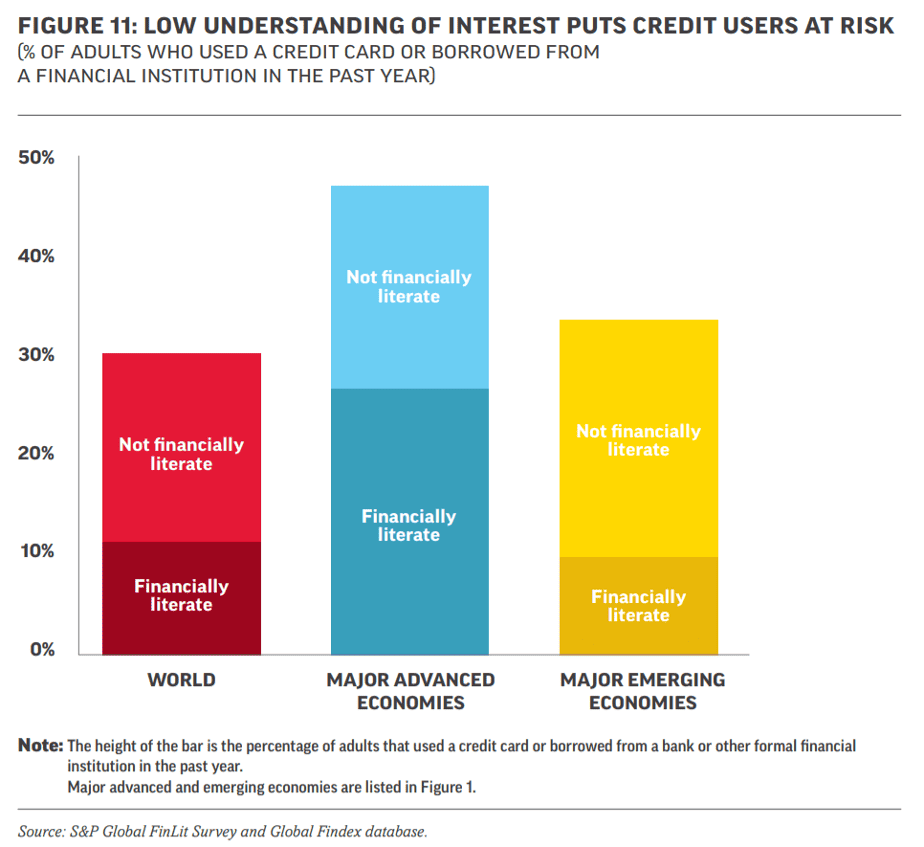
4. A low understanding of interest puts you at risk

A chart showing low understanding of interests puts credit users at risk.

Credit cards, personal loans, and other lending programs are gaining traction, even in many poor countries. Yet, the percentage of adults who understand the concept behind it remains stagnant. Many short-term credit users do not fully grasp the idea of interests, and the pace at which it compounds the total amount owed. Only a handful can perform simple calculations related to interest.

Based on the chart, there are generally more financially illiterate adults worldwide and in the major emerging economies (poor countries) who borrow money — and the reason, perhaps, is they are not aware of their implications.

For instance, 32 percent of adults in Brazil own a credit card. But of the 40% of them who are financially literate, only half understand compound interest. The same case in Turkey. 33% are credit card owners, yet merely half of the 29% of the financially literate population knows the concept.

The costs of financial ignorance are significant. Those who do not know how compound interest works may spend more on transaction fees, incur higher interest rates on loans, and get into greater debt. As a consequence, they borrow more and save less.

Now let us contrast that to the 53% of adults in major emerging economies who use credit. They have more financially literate individuals who borrow money — and the reason may be because they know how to use it properly. Researchers have found financially educated adults will generally be less likely to default on loans and more likely to save for their retirement.

I am a firm believer in living within your means, thus I do not advocate borrowing money. But if you really need to, understanding the concept of compounding interest will minimize your risk of financial disaster.

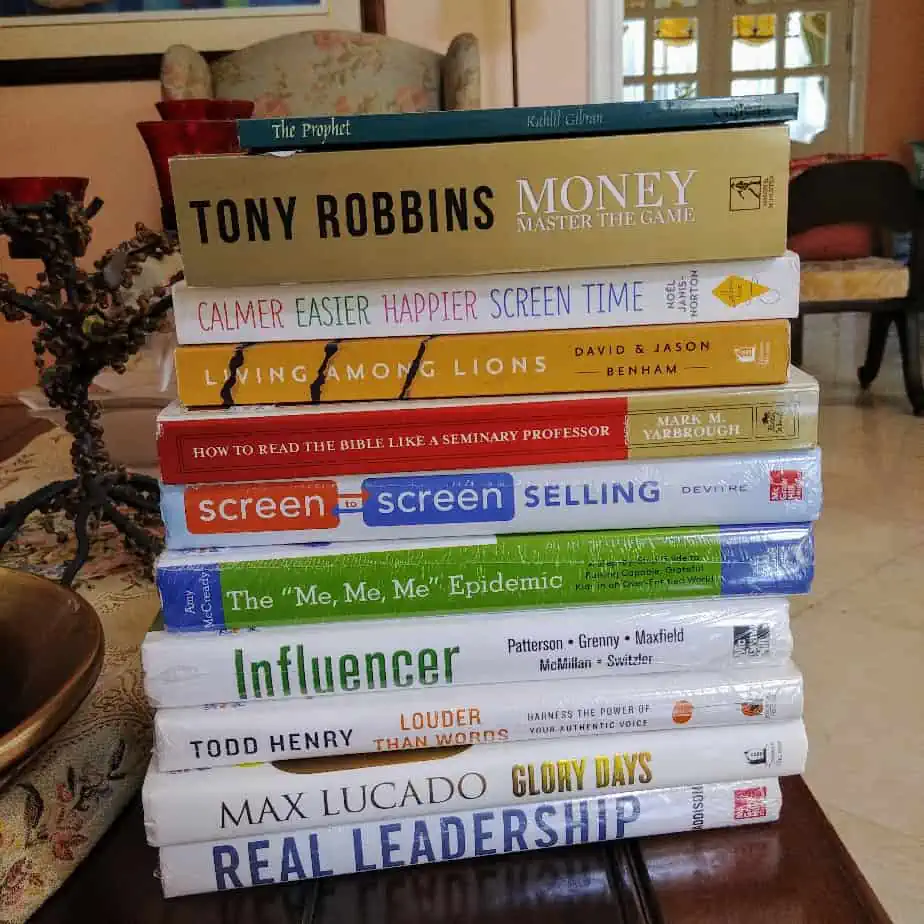
A photo of a pile of nonfiction books.

5. Money-savvy people seize more opportunities.

Learning about money allows us to take advantage of various opportunities to secure and grow our assets. It is especially vital today since there is an increase in financial products that are easily accessible via mobile devices. One of the fastest-growing is Mobile Banking.

Opportunities in mobile banking

Mobile banking allows its customers to transact remotely via smartphones, tablets, and computers. Some of its notable services are:

  • Pay, send, and receive money digitally.

With digital payments, users will not only save time in paying their bills, but it also empowers them to improve their businesses by being able to accept cash or credit transactions online.

  • Get higher interest rates on savings account.

Most digital banks do not maintain a brick-and-mortar store. The expenses they saved allow them to give more interest to their customers than what traditional banks offer.

If a traditional bank gives 0.125% per year, a digital bank can offer 2.5% to 4%.

  • Apply for personal loans.

Some digital banks, like Tonik, allow you to apply for a loan within its app.

  • Invest in various investment funds.

Digital wallets such as GCash enable you to invest in various funds such as index funds, money market funds, bond funds, and some international feeder funds.

If you would like to learn about these mobile banking apps, you can check out these posts:

For many, having a bank account is an essential step to participate in the country’s financial system. Account holders who have access to digital payments are, in general, more able to save money, provide for their families, and withstand economic setbacks. This is the reason why governments in many countries are boosting the use of these financial services.

Most account owners and non-owners are not well versed financially.

Unfortunately, due to their lack of knowledge about money, both account owners and non-owners worldwide are underutilizing the benefits of financial infrastructures available today.

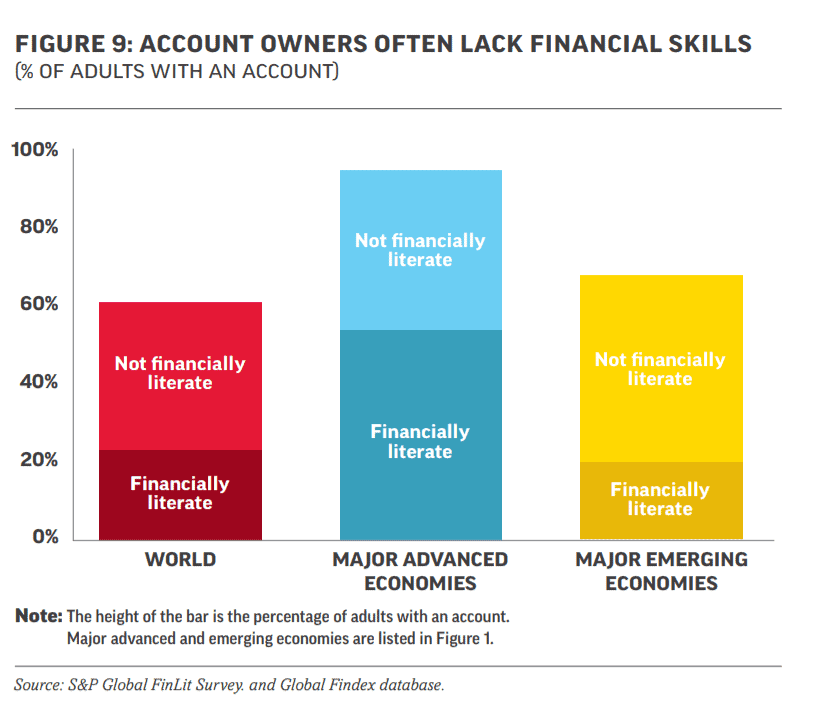
Account owners tend to be savvier, but plenty of them still lack financial skills.

A chart showing that account owners often lack financial skills.
  • 38% of adult account owners worldwide are financially literate.
  • 57% for the major advanced economies;
  • and 30% in major emerging economies.

With that said, there are also micro gaps existing in financial literacy among account holders even though they typically have stronger financial skills than the general population. 

For instance,

  • A man with an account is 8% more likely to be financially educated than a woman with an account.
  • Similar disparities can be found between households in the richest 60% and the poorest 40%. 
  • Primary education holders are half as likely as their secondary education counterparts to be financially literate.

One banking feature account owners who lack financial knowledge might not be fully benefitting is savings.

  • 57% of adults save money, but only 27% entrust their funds to a bank or other registered financial institution.
  • Others tend to lean toward unsafe and less lucrative methods, such as keeping cash in a depository safe or stuffing it under a mattress.
  • Only 42% of these adult account owners worldwide actually use their accounts to save — and 45% of them are financially literate.

If only these savers improve their financial skills, they are sure to make their money yield better results.

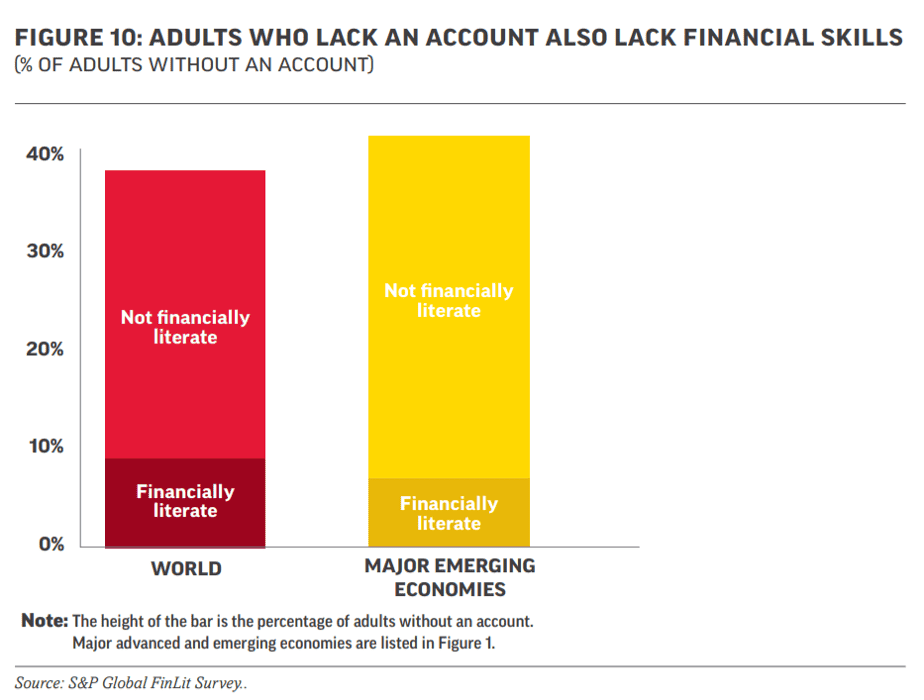
But adult non-account owners exhibit even weaker financial skills.

A chart showing that adults who lack an account also lack financial skills.
  • 25% of non-account owners worldwide are financially literate.
  • 22% for the poor countries.

There is no definitive evidence of whether low financial knowledge makes people shy away from using any financial services. According to research, 59% of “unbanked” adults say they do not have enough cash to use an account. But in actuality, most people in poverty also make various payments and other financial transactions every day. The only difference is they do it informally, which puts their money at risk in many ways.

The most basic explanation for non-account owners having low financial skills is their background. Most of them come from poor or less educated households and were not exposed to the different financial facilities.

If they were only more aware of how money works, these non-account owners would definitely be more inclined to open one. The notion of interest in a savings account, for instance, would show them how their money can make more money over time. Furthermore, their money inside the bank greatly reduces the chance of it being lost, destroyed, or stolen.

There are many more opportunities in the financial world right now. But most people are not maximizing simply because they lack knowledge about money.

6. Most homeowners are financially literate.

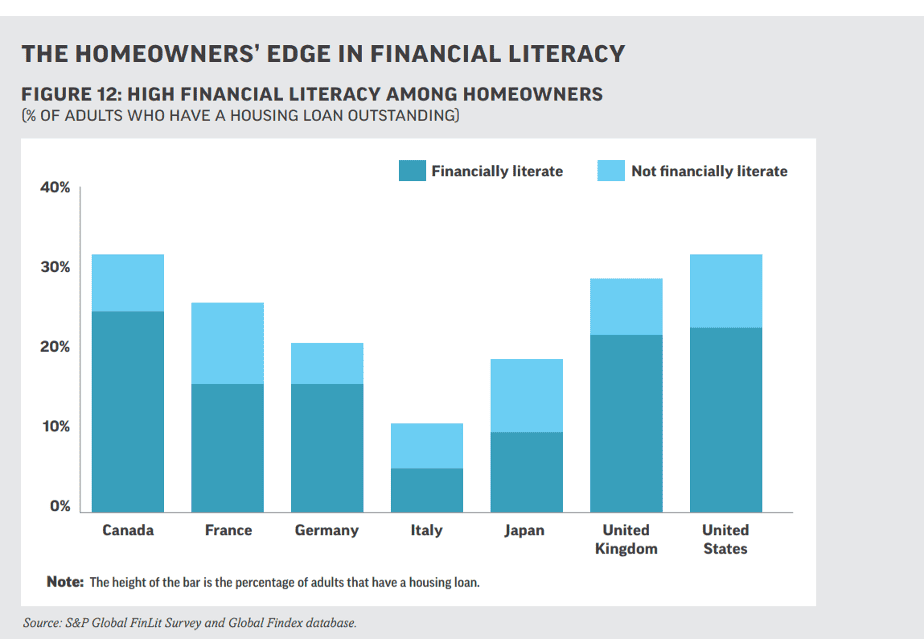
A chart showing high financial literacy among homeowners.

Since purchasing a house requires advanced calculations, it is expected that most homeowners have better financial skills than the average person overall. The chart above indeed confirms it. 26% of adults in rich countries have outstanding home loans.

Nonetheless, it is still a fact that not all home buyers are financially literate.

In the United States, 3 in 10 adults with a housing loan are unable to do the basic interest computation on their monthly loan payments. Same problem in Japan. Only 37% of the one-fifth of adults with loans understand compound interest correctly.

In a nutshell, those who are financially literate have a higher chance of really owning their own homes because they are less likely to default on their payments.

A photo of another pile of books.

Bonus: Financial literacy helps reduce anxiety about life in old age.

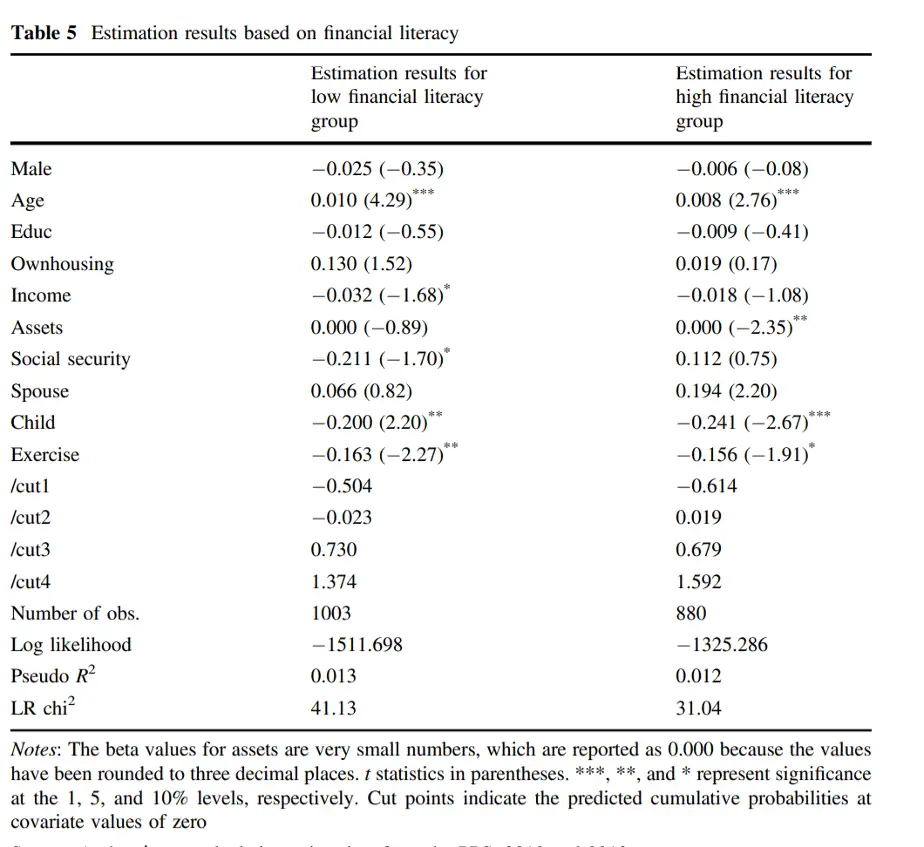
I was debating about whether to include this data or not. I would love to share the findings, but I am having difficulty interpreting the chart for you. So, to solve my problem, I will have this section as a bonus instead.

A table of estimated results based on financial literacy.

I hope you can grasp the table above. But what the data shows is that financially educated people are more able to earn income and build assets, which leads them to have a less anxious life in old age.

As for the less financially literate people, they rely more on social security to help them in their senior years as they are unable to accumulate sufficient income-generating possessions.

Besides these, other factors also help reduce anxiety in old age:

  • Having a child.
  • Doing regular exercise.
  • Good marital status.

Many countries are facing aging populations with smaller public pensions. They are now calling on their citizens to take a more serious role in planning for their retirement. With recent changes to pensions, individuals now carry the financial responsibility for their twilight years. They are rather discouraged from depending solely on their employers or the government.

But study shows many are unprepared.

In Central and Eastern European countries, younger adults are not saving enough for old age. And senior citizens do not have the essential skills to deal with the economic challenges of retirement. As a whole, only 47% of those who do not prepare for old age in the EU show an understanding of basic financial concepts.

Statistically, people with strong financial skills are more likely to invest in several ventures to prepare themselves for life in old age.

A photo of a boy wearing shades sleeps on his car seat.

Closing Thoughts

Financial literacy challenges and confronts both the rich and the poor alike. Although there are more financially skilled among the wealthy and educated, it is clear there are billions who are unequipped to handle the rapid changes in the financial world.

Unless people are willing to hone their economic abilities, these transitions can easily lead to high debt, mortgage defaults, or even bankruptcy.

A person will not be able to make sound financial decisions without understanding basic financial concepts. Only knowledge will give you the confidence to make wise choices about saving, investing, borrowing, and more.

Learning about money is one of the greatest investments you can make in your life.


Sources:


Follow the Journey

This journal is my way of making sense of the lessons from the journey. Get the next full entry delivered straight to your inbox.