How Do You Earn in GInvest? (Simplified, Tips, Review)

If you are following this blog, you know I like to keep things simple. I am not an expert in many areas in life – which include investing – but I am a passionate learner. Learning and sharing what I learned is what I do. A few years back, I wrote a post about why it is smart to save with GCash. I explained in simple terms what it does and how it can help you protect yourself from inflation.

Today we will take a look at GCash’s investment feature called Ginvest.

As a whole, an investor earns money in GInvest through Capital Gains. It means buying shares (or units) low and selling them high via the GCash app. Your money generally will earn from dividends or interests depending on which fund you have invested.

To do this, you need to access GInvest in the GCash app and invest in the funds you are comfortable with. Those funds are managed by reputable asset management companies like ATRAM and BPI, so they are generally safe.

Intelligent Investor book with market and cell phone with GCash app.

How GInvest work?

To put it simply, GInvest serves as your agent for investing in different mutual and trust funds offered by ATRAM and BPI. The reality is not everyone is eligible to invest in these funds. There are certain requirements you have to meet before you become an accredited investor. Investing via GInvest removed that barrier for you. You no longer need to go through that process since GInvest is technically investing on your behalf.
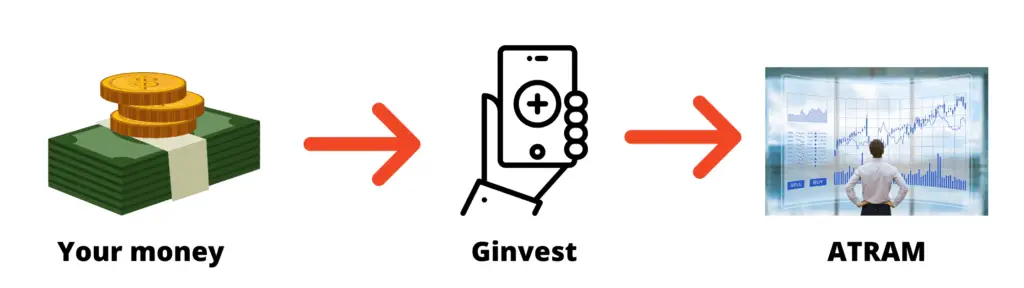
Ginvest to Atram
A simple illustration of how GInvest works.

What happens to your money when you invest?

It varies on what investment product you choose. But in essence, GInvest forwards your money to the asset management company. The money is then used to lend or buy ownership (equity) from a business.
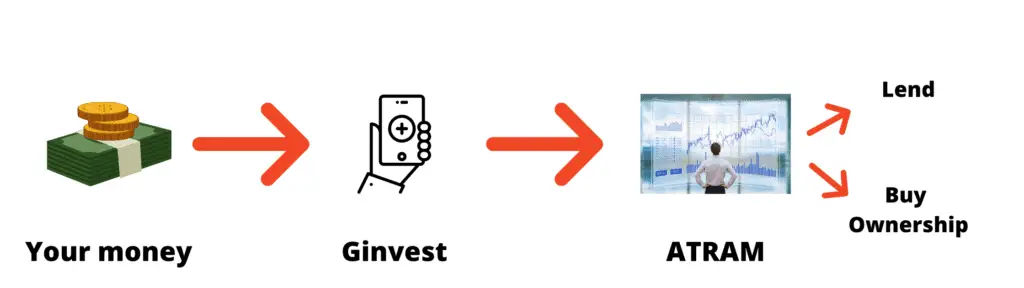
Your Money to Ginvest to Atram to lending or buy stocks.
A simple illustration of what happens to your money when you invest via GInvest.

Fixed Income

When our money is used for short-term or long-term loans, it will earn interest upon return. This is mostly referred to as a fixed-income investment — because it gives regular monthly earnings. Fixed income investments are generally safe but make less profit.

Dividends

Another way to use our money is to buy stocks and become part-owners of different companies. As shareholders, we get to earn a percentage of the income known as dividends when the business performs. But at the same time, we can also suffer losses when their performance flounders. Consider equity as a high-risk, high-return investment option.

This is a quick overview of how we can earn in GInvest. But please take note, whatever we earned (or lost) in GInvest will only remain “on paper” until we sell our shares. As mentioned above, an investor only makes actual money when he sells at a higher price.

Where to invest in GInvest?

Where you invest in GInvest will depend heavily on your risk appetite and strategy.

Risk Appetite

All investing platforms, including GInvest, will require you to fill out a risk appetite assessment form before they allow you to start investing. Some call this risk tolerance form. They will ask questions that will help you evaluate whether you’re an aggressive, moderate, or conservative type of investor. This process will give you clarity on which funds are suitable for you.

  • Aggressive investor: Your priority is to earn the maximum amount possible. You do not mind the risk too much.
  • Moderate investor: You value growth but are also mindful about the risks involved.
  • Conservative investor: It’s okay to earn little as long as you do not lose your money. Capital preservation is your main goal.

Here are the available funds in GInvest based on your risk appetite:

Risk AppetiteFundAsset Manager
AggressiveALFM Global Multi-Asset Fund Inc. – PHPBPI-IMI
AggressivePhilippine Stock Index Fund (Units)BPI-IMI
AggressiveATRAM Philippine Equity Smart Index FundATRAM
AggressiveATRAM Philippine Sustainable Development And Growth FundATRAM
AggressiveATRAM Global Equity Opportunity Feeder FundATRAM
AggressiveATRAM Global Consumer Trends Feeder FundATRAM
AggressiveATRAM Global Technology Feeder FundATRAM
ModerateATRAM Global Health Care Feeder FundATRAM
ModerateATRAM Global Infra Equity Feeder FundATRAM
ModerateATRAM Total Return Peso Bond FundATRAM
ConservativeATRAM Peso Money Market FundATRAM
Table of the current funds in GInvest based on risk appetite. (Updated Feb 27, 2023)

Strategy

You can start investing in the funds appropriate for you once you determine your risk appetite. Feed it with about 15% of your income a month for the next five to ten years, and you should be fine. But if you want to optimize the returns of your investment, you will need to apply some investment strategy. One basic strategy in investing is called diversification. It’s a practice of spreading your investment in two to three funds to minimize risk or earn better returns.

Here are some samples of a diversified asset allocation based on risk appetite:

Aggressive

ATRAM Philippine Equity Smart Index Fund 80%
ATRAM Total Return Peso Bond Fund20%
Ginvest aggressive asset allocation: Sample 1
Philippine Stock Index Fund (Units)50%
ATRAM Global Technology Feeder Fund35%
ATRAM Total Return Peso Bond Fund15%
Ginvest aggressive asset allocation: Sample 2

Moderate

ATRAM Philippine Equity Smart Index Fund50%
ATRAM Total Return Peso Bond Fund50%
Ginvest moderate asset allocation: Sample 1
ATRAM Global Health Care Feeder Fund50%
ATRAM Total Return Peso Bond Fund40%
ATRAM Peso Money Market Fund10%
Ginvest moderate asset allocation: Sample 2

Conservative

ATRAM Total Return Peso Bond Fund80%
Philippine Stock Index Fund (Units)20%
Ginvest conservative asset allocation: Sample 1
ATRAM Peso Money Market Fund70%
ATRAM Total Return Peso Bond Fund20%
ATRAM Global Consumer Trends Feeder Fund10%
Ginvest conservative asset allocation: Sample 2

If you want to learn more about this and become a better investor, I highly recommend you take the on-demand video course below. This is the investing model I currently follow, and it has made investing become part of my lifestyle. Education will always be one of the best investments you can make for yourself.

Man with hat lying on the beach looking at his tablet.
(Click image to preview the course)

The Lazy Investor Way is for people who want to have a more simplified approach to their investments.

What are the best investment products in GInvest?

The best investment products in GInvest are those with the lowest fees. Investing is not only about how much you earn, but also how much you keep. Mutual funds and Unit Investment Trust Fund (UITF) normally charge an annual management fee, an early redemption fee, and transaction fees. Investing in a high performing fund doesn’t matter when your profits only go to its expensive costs.

Upon checking, I couldn’t find the funds’ fees in GInvest. Looking for things isn’t one of my best skills, so I might have just missed them. Anyway, if you also couldn’t find them, I did my research and put them in a table below to help you make a better decision.

FundManagement FeeEarly redemption fee (holding period)Transaction fees (approximately)
ALFM Global Multi-Asset Fund Inc. – PHP1%1% (< 180 days)5%
Philippine Stock Index Fund (Units)1%1% (< 90 days)3%
ATRAM Philippine Equity Smart Index Fund1.5%None (0 days)0.07%
ATRAM Philippine Sustainable Development And Growth Fund1.76%None (0 days)0%
ATRAM Global Equity Opportunity Feeder Fund1.15%None (0 days)0.01%
ATRAM Global Consumer Trends Feeder Fund1.15%None (0 days)0.02%
ATRAM Global Technology Feeder Fund1.15%None (0 days)0.01%
ATRAM Global Health Care Feeder Fund0.96%None (0 days)5.43%
ATRAM Global Infra Equity Feeder Fund1.03%None (0 days)3.71%
ATRAM Total Return Peso Bond Fund1.10%None (0 days)0.03%
ATRAM Peso Money Market Fund0.49%None (0 days)0.04%
Table of the funds’ fees and expenses available in GInvest. (Updated Feb 27, 2023)

What is the minimum investment amount required in GInvest?

You can begin investing with fifty pesos. GInvest made it possible for every adult to become an investor. Back in the day, only the wealthy were the ones who could afford to invest. It’s one of the reasons why the rich get richer.

Here are the funds you can invest in if you have at least Php 50.

FundMinimum investment amount
Philippine Stock Index Fund (Units)Php 50
ATRAM Philippine Equity Smart Index FundPhp 50
ATRAM Philippine Sustainable Development And Growth FundPhp 50
ATRAM Total Return Peso Bond FundPhp 50
ATRAM Peso Money Market FundPhp 50
Table of the funds’ in GInvest with minimum investment amount of Php 50. (Updated Feb 27, 2023)

It’s good to start somewhere, but I hope you won’t be content with investing Php 50 throughout your life. Don’t get me wrong. Fifty pesos is fifty pesos. With today’s economic challenges, I know people who struggle to save this amount each month. But the reality is that the returns for this investment capital are too small for your effort. Earning 1% from a Php 50 investment is very different from Php 1,000.

I am not suggesting you shouldn’t invest your fifty pesos. I would still encourage you to invest it with the intention of building your investing muscle. Don’t think about the profit first. Use this amount to learn the game. But from a purely return-driven perspective, my suggestion is to put your fifty pesos in GSave instead. There you can get a steady 2.6% return per year without the fees. The idea is to use GSave to grow your Php 50, then transfer it to GInvest when you have at least Php 1,000 or more.

These are the funds in GInvest with a minimum order amount of Php 1,000.

FundMinimum investment amount
ALFM Global Multi-Asset Fund Inc. – PHPPhp 1,000
ATRAM Global Equity Opportunity Feeder FundPhp 1,000
ATRAM Global Consumer Trends Feeder FundPhp 1,000
ATRAM Global Technology Feeder FundPhp 1,000
ATRAM Global Health Care Feeder FundPhp 1,000
ATRAM Global Infra Equity Feeder FundPhp 1,000
Table of the funds’ in GInvest with minimum investment amount of Php 1,000. (Updated Feb 27, 2023)

I started investing with a sum of Php 7,000 on February 5, 2017. But prior to that, I have already been saving regularly for the past 6 months. I was broke and deeply in debt, so it’s really a struggle for me to save. I wasn’t even sure if it’s wise for me to start investing – given my pressing financial situation. You can read about my story here. And also here. But small steps can take you to great places if you do it consistently for a long time. Today I praise God that I am completely debt free, and my investment fund has grown from Php 7,000 to more than Php 500,000.

Investing is not a one-time big-time affair. It is a habit. Once you begin investing, make it a practice to put at least 10% of your income into the fund each month.

Can you lose money in GInvest?

No investment is 100% safe. Money in GInvest is also exposed to different types of risks that can diminish its value. Such risks include market risk, business risk, inflation risk, credit risk, and more. To manage them, an investor must be aware of his risk appetite, strategy, goals, and investing capacity.

As a rule of thumb, one should never invest in things they do not understand. That’s why I highly recommend you take an online course like the one above if you are serious about investing. Many people believe investing is in the same family tree as gambling or the lottery. They view it as a venture purely based on “luck”, thus, they see no sense in studying about it. But nothing can be further than the truth. As mentioned previously, there are strategies or approaches that will help you grow your investments the right way.

What’s good about investing is that despite the risks, you can win almost every time as long as you have patience. Do you remember what I told you at the beginning of this post? Earnings and losses will only be “on paper” until you actually sell your shares. Take a look at an actual example of one of the funds I invested in Ginvest.
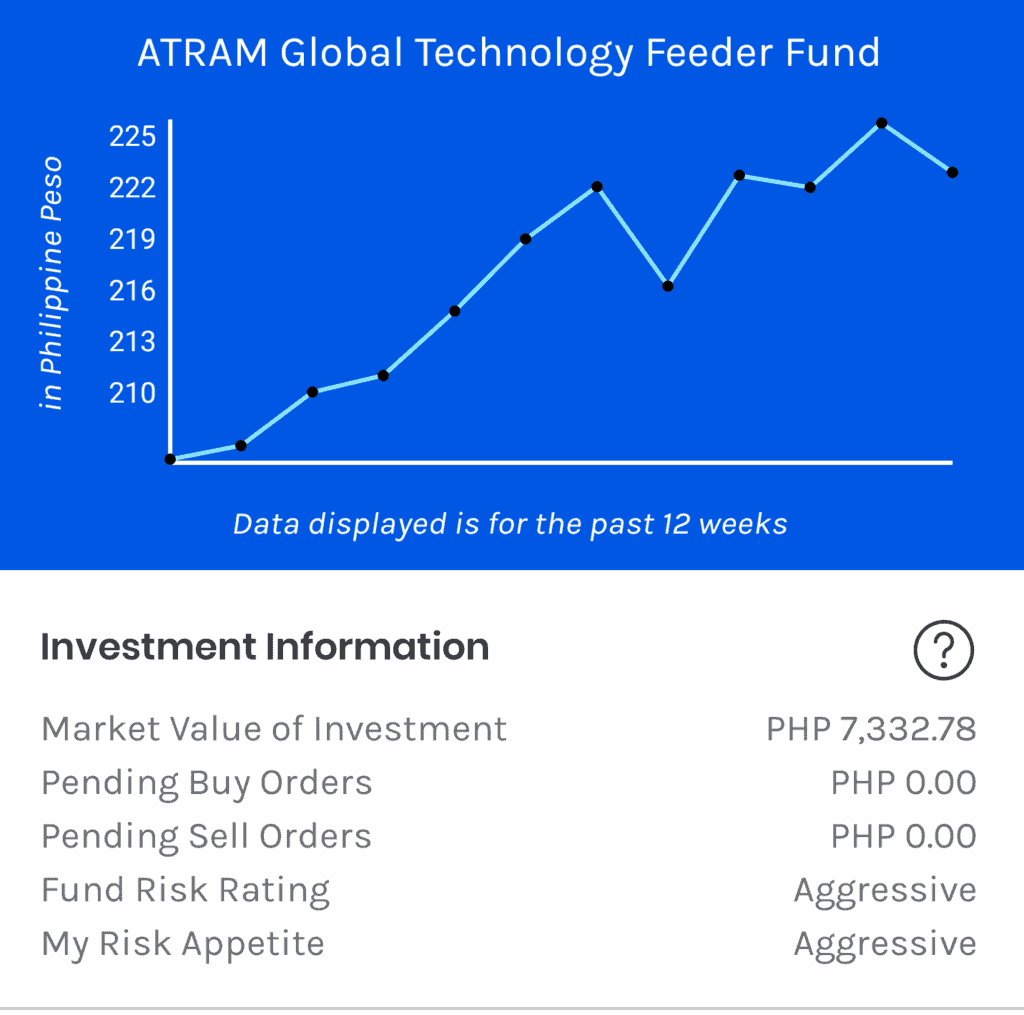
Atram global technology feeder fund end of 2021.
My ATRAM Global Technology Feeder Fund investment value by end of 2021.

In 2021, I put Php 10,000 into the ATRAM Global Technology Feeder Fund. As you can see, by the end of the year, my investment value was down to P7,332.78. If I sold my shares that day, I would have suffered an actual loss of Php 2,667.22.

In 2022, I decided to not add anything to this account and just let it sit for a year. I checked on it recently and this is its value now:
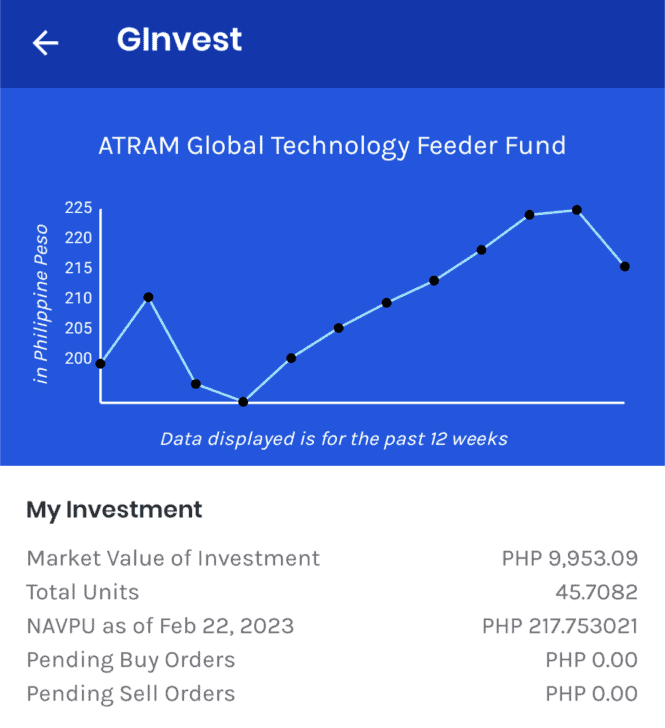
My ATRAM Global Technology Feeder Fund investment value Feb 2023.

It’s still down, but not as much as in 2021. I could sell my shares today and just get an actual loss of Php 46.91 instead. But why would I do that? I always play the long game, so I am not bothered by these losses as long as I see the potential to make money in the future. I plan to let it continue to sit for now.

So what’s the key takeaway? Do not sell your shares when they are down! (Unless, of course, you need the money for an emergency.)

Be patient. Play the long game.

When to sell in GInvest?

Generally, it is smart to sell your shares in GInvest when it reaches your goal. Alternatively, it is also prudent to exit when you find a better investing opportunity, or when the fund is needed for emergency situations.

Selling your shares or exiting from an investment fund is purely a personal choice. There is no right or wrong answer. While it’s always good to sell when your investment is up, this is not a good selling indicator overall. As a whole, I rarely sell my shares. But here are the situations where I had sold my shares:

I sell when there’s an emergency or a great need.

It’s imperative to have an emergency fund before you start investing. This will prevent your money from going in and out of the market. An emergency fund is a savings of at least 3 to 6 months of your living expenses, and you will only use this when unforeseen events arise.

Sadly, we lost our businesses during the pandemic. It’s more than what our emergency fund could bear. I had no choice but to sell my shares to sustain my family while we tried to bounce back.

I sell based on a goal or a target date.

My wife and I struggled mentally during the pandemic. This was late 2020 or early 2021. It’s a feeling of as if someone suddenly turned off the lights in the hallway, and we can’t see where we are heading. I’m sure many of you also felt this way. To keep our sanity, I told my wife that we should give ourselves something to look forward to. We both agreed to plan a trip to Japan by 2023.

By faith, we invested continuously into our money market fund for this purpose. We did it even though we were not even sure if it’s already safe to travel by then. Last month, I already sold some of our shares to buy our tickets.

I sell when there’s a better investment opportunity.

Another instance where I sold my shares was when I got a big deal from a client. Besides this blog, I also have another online business. It’s an e-commerce site for Chromebooks. I have a fund dedicated to it. Yet, I have to tap into my other investment funds every time a customer orders more than its capacity. I sold my shares even though the fund was down during that time because I know it will earn a hundred-fold more in that transaction. I’d then return the borrowed amount plus interest to the fund after I receive the payment from the client.

As investors, we need to determine our goals, purpose, and priority. This will help us make sound decisions every time we sell. Being a father, my overall priority is my family. I invest because I want to be more present in their lives. Investing as well as running online businesses are my one-two punch in providing for my children while being a dad at home.

If you prefer to invest with other investing platforms in the Philippines, here are a few of the notable ones:

  • COL Financial
  • First Metro Securities
  • BPI Trade
  • BDO Securities
  • Philstocks

GInvest Review

Also, note that there are no perfect investment platforms. My suggestion is to find one you are comfortable with and easy to use. Here are my quick pros and cons I observed with GInvest:

Pros

  • Easy to use.
  • Partnered with reliable asset management companies.
  • Very affordable minimum investment deposit.

Cons

  • Limited fund options.
  • Incomplete fund information or details.
  • Some cash-in and transfer options are subject to service charge.

GSave or GInvest?

GSave is a form of high-interest savings account, while GInvest offers UITF and Mutual Funds. Both are helpful financial tools to make your money earn interest. GSave is the safer option as it gives a fixed monthly interest. GInvest, in contrast, can deliver higher returns but comes with a level of risk.

Summary

You make money in GInvest by buying low and selling high. Your money earns interest or dividends through fixed-income or equity. But these are only on paper until you actually sell your shares.

Risks will always be part of investing. So you should get familiar with your risk appetite and strategy. Losing money in GInvest is highly possible, especially if you do not understand the proper techniques of investing. This is why it’s imperative to take a class such as this one before you start. If you find investing too risky, perhaps GSave is a better option for you.

More From The Learning Dad Blog

Sources


Follow the Journey

This journal is my way of making sense of the lessons from the journey. Get the next full entry delivered straight to your inbox.

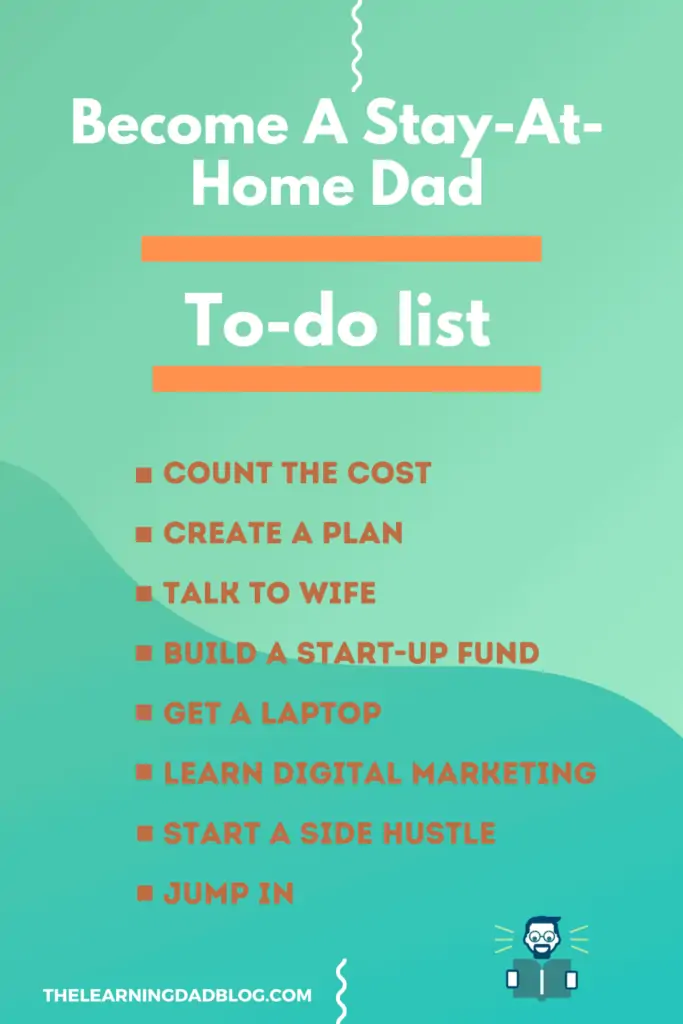
How To Become A Stay-At-Home Dad: Financial To-Do List

I have been a stay-at-home dad (SAHD) for four years now. It was something I never expected to be. My business failed, and I got myself in a pile of debt, which forced me to stay home and start anew. But if I had to start over again, this would be my to-do list to become a SAHD.

Before I proceed, I would like to mention that this post leans more on the economic side of the process. Many fathers desire to stay home with their wives and children but can’t due to financial concerns. If we can solve the money issue, it is more apparent that parents will be inclined to stay home with their kids.

You can read my origin story here: — Assets and liabilities management: Our simple plan to financial freedom.

how to become a stay-at-home dad -- to-do list

This post may contain affiliate links. — Please read our full disclosure.

Count The Costs

Can you afford to make the transition?

Let us do a little math. How much are your monthly expenses, and how much money do you have in the bank? We should anticipate the months when our income will drop. Give it at least six months to a year before we can legitimately make money at home.

As I look back, my financials look like this:

  • $60 in the bank
  • $0 income
  • $??,??? in debt

I cannot afford to stay at home. But thankfully, I have supportive parents. They allowed me and my family to stay with them until we figured things out. By God’s grace, we were able to move out by September 2019.

Create A Plan

Many would suggest we should talk with our wives first before we create a plan. But I don’t think it is a good idea, especially when you have financial troubles. It is more favorable to approach her with a rationale and a plan on how to make it work.

Here are some questions we have to ask ourselves when creating a plan:

What do I have?

It would be a handicap to start something out of thin air. I felt lost when my business failed. It was a point where I did not know where to go or what to do with my life.

But eventually, I found a mentor who taught me one of the greatest lessons in my life. He said, “Always start with what you have.

God is there to guide us and equip us for our journey,” he added. “So if we need direction, the clue is already in our hands.

Ask yourself, what skills, passion, resources, and connections do I have? 

Skills — What are you good at? 

Passion — What do you love doing?

Resources — Do you have cars, properties, or any other assets? 

Connections — Who are the people you know who can help you? What are their products and services?

List everything down in a notebook, or you can also create a mindmap to make it visual.

How will I make money at home?

Now, based on your answers, list some ideas on how you will make money at home. I shared my list and how much I earn annually in this post.

Then, do some research and make a conservative estimation of how much you can make per idea. Conservative is about 50% less than what you have projected.

Example: (Estimated monthly earnings)

Online buy and sell = $300
Freelance work = $200
Blogging/Vlogging = $100
Real estate = $600

The activity will give you a general outlook of what income to look forward to at home.

Who are the people who might be affected negatively by my decision?

In my case, it was my employees. It was painful to let them go, but I did not have any choice. I issued their separation pay and delivered a heads-up in advance to give them enough time to plan.

How about you? Who will be the collateral damage when you transition to staying home full time? Identify these people and make the necessary move to make the upcoming change easy for them.

Talk To Wife

Ah, this one is a nail-biter. But do not worry, we have prepared well for this day. The worst thing we can do is give our wives the impression that we are acting on impulse. Having a plan will assure them of how we have prayed and meditated about this matter thoroughly.

But still, we do not know 100% how our wives will react. Let us have an open heart and be understanding of whatever emotion they may feel during the talk. We do not want to turn this matter into a debate. Whatever she says, let us listen and take notes.

Our wives are a source of wisdom we often overlook. They have these insights we will never realize unless they tell us. But whatever the case, we aim to have a productive discussion with her.

I interviewed my wife about her experience of living with me as a work-at-home husband. You can read the transcript here.

Build A Start-up Fund

After we have settled it out with our wife, we can now proceed to the next task: Build a start-up fund.

We do not want to jump out the window without any cushion awaiting us on the ground. Also, we do not want just any cushioning. We want something thick enough to handle the impact. It is the same concept when it comes to our finances.

We will never know when our income will recover once we finally give up our position in a company. It will take time before we’ll earn our first dollar at home. For this reason, it is vital to have some financial cushion of at least six months to a year of living expenses. It should be a sufficient lead time for us to figure out how to earn money at home.

But building our start-up fund is no easy feat. It may take too long before we can accomplish this assignment. That is why we need to make some sacrifices to tick off this task.

Here are the sub-tasks for building our start-up fund:

Sell Stuff You Will No Longer Use

I heard an average person owns about 300,000 items. There sure are tons of stuff we can turn into cash there.

Let us start with the big-ticket items from the list we’ve done earlier. Remember? In the Create A Plan, we took inventory of your available resources?

During my time, I sold my MacBook, basketball shoes, and golf clubs. I also disposed of everything I have not used for the past six months. All in all, I was able to add about $1,000 to my start-up fund. — which is a little over a month worth of our family’s living expenses.

Cut Unnecessary Monthly Expenses

Another way to push our savings is to cut our expenses. Take a look at your monthly expenditures and see if there is anything you can discard.

Mine was an NBA League Pass and a mobile postpaid plan. I unsubscribed to NBA and replaced my postpaid with prepaid.

I have saved about $30 a month.

Negotiate Debts

It is essential to pay off all credit card debts before you become a stay-at-home dad. The last thing you want to do is return to your job because the interest and penalties have already piled up. You can check how we paid off our eight credit cards here.

For long-term debts, such as home and business loans, the best way to handle them is to negotiate with the bank. Request for payment restructures to ease your load until you get stable financially.

You can read how my wife and I dealt with our liabilities here: Assets and liabilities management: Our simple plan for financial freedom.

Get A Laptop

I am sorry, but I have to ask you to invest in a laptop. I presume you already have a smartphone? If not, you also need one of those. You will need a computer and a phone to make money at home. I cannot think of other ways to earn without those two devices. But if you only have to choose one, go for the laptop first.

You do not need the latest and greatest. I usually go for the mid-range category. Not too advanced to waste my money on features I do not need. And not too low-end that I will need to replace the device in a couple of years. Aim for something you think will last for five years.

What I use now is the Acer Chromebook Spin 713. You can check it out on Amazon using my affiliate link here: Acer Chromebook Spin 713. It cost about $515. I love this laptop, but in reality, the specs are already a bit more than you need. It has an Intel Core i5 processor with 8 GB of RAM, and 128 GB of SDD storage. Good for future-proofing.

For starters, an Intel Core i3 processor with 8 GB of RAM is the sweet spot. You may save a few bucks with the Lenovo Chromebook Flex 5, which costs about $424. Here is the link to Amazon: Lenovo Chromebook Flex 5.

If you are from the Philippines, you can check out Chromebook Store PH. But, of course, their prices will be a bit higher due to taxes, shipping, and handling.

If you want to learn more about Chromebooks, you can check out our Chromebook resource page.

Learn Digital Marketing Fundamentals

“The more you LEARN, the more you EARN.” I cannot agree more with this saying, especially when it comes to making money online.

The bulk of what we will do at home is online selling. We have to get familiar with the platforms and techniques for effective salesmanship. Digital marketing is such a broad topic that we can get lost if we try to learn everything. My suggestion is to start with the basics and then branch out to where you are most interested.

Check out this starter course on digital marketing: Digital Marketing Fundamentals | Learn From Fiverr

Another skill we have to learn: Writing

The remaining money I had in my savings was all spent on learning. I bought books, enrolled in online classes, and signed up for seminars. I tried to gain as much knowledge as possible to set up my next business on the right foot.

One of my best investments was in writing.

Writing will be present in every part of our business. It is the way we communicate and sell to our customers. Even if you go to vlogging or podcasting, you still need to write your scripts and stories. Being an excellent writer is a huge advantage in making money online.

Pro-tip: With writing, you can also create and sell info products. (e.g., ebooks, premium email newsletters, etc.)

Check out this copywriting course: From Structure To Style: Master Your Copywriting | Learn from Fiverr

If you want to take it a level higher, you can check out MasterClass. There, you can learn how to write from renowned authors and writers. You can get unlimited access to all its courses for $180 a year.

Start A Side-Hustle

You will discover many ways to earn money at home. But the problem with them is it usually takes a long time before you make your first dollar.

(What you need to accomplish on average to make money)

  • Blogging/E-commerce: 10,000 to 30,000 page views a month.
  • Vlogging (YouTube): 1,000 subscribers + 4 hours watch time.
  • Podcasting: 3,000 to 5,000 listeners.

It will take you, on average, twelve to twenty-four months to build an audience and traffic. Not to mention the amount you need to spend on equipment to create content.

One of the early ways I made money at home was through being an internet middleman. It is fast and easy to start. But the best part is you do not need to shell out too much money to set it up. All you need is credibility and a heart of service.

An internet middleman serves as a bridge between the supplier and the customer. 

I used to post ads for van and bus rental services even though I do not own a fleet of vehicles. Once there is an inquiry, I will ask the company for a quote and then forward it to the customer with my mark-up. I did this for two years without even meeting the suppliers and customers face to face. It is kind of awesome when you think about it.

I already shared the link to this article earlier, but I will share it again in case you missed it. How much do stay-at-home dads make? — There, I shared some ways we can make money at home. I hope it will spark ideas for your side hustle.

But if you also intend to start as an internet middleman, here are the steps on how to do it:

  1. Reach out to potential suppliers. 
    Review your connections list. — The one we did on the Create A Plan task. Choose products you are already familiar with.
  2. Study the products/services.
    Ask for their price list and check if they have special discounts for resellers. Research the uniqueness and the competitiveness of the product. Check the demand and, more or less, how much you will earn per transaction. 
    Pro-tip: Choose products where you can make at least $20 to $30 per transaction. You want to engage in products that are worthy of your time.
  3. Create a public profile
    Building trust is your utmost priority when doing business online. Open your Facebook profile to the public and make it look professional. If you prefer to keep your privacy, another option is to create a public profile with About Me.
  4. Set up bank accounts where people can transfer their payments.
  5. Post ads for the product or service in Facebook Marketplace, Carousell, or eBay. 
    Boost your ads for better results.
  6. Serve your customers well. Be transparent with your supplier.
  7. Rinse and repeat.

Jump-In

Here is your final task: jump in!

You are finally at this moment. Congratulations, you have earned it!

You may feel a bit nervous, but do not worry, it is normal. It is only due to some sort of separation anxiety from your old lifestyle.

But how would I know if I am ready to jump in?

Ah, good question!

You are ready to crossover when you have cleared your credit card debts and built your start-up fund.

Closing Thoughts

Reality check: It is only the beginning.

I do not want to burst your bubble. Being a stay-at-home dad has its benefits, but it also comes with a lot of challenges. You may get anxious about the finances, experience burnout, or even be criticized for being a SAHD.

But keep your head up, brother. You made a noble move for your family. May God give you strength, wisdom, and encouragement.

Enjoy the journey.


Keep In Touch


Thank you for reading!


Follow the Journey

This journal is my way of making sense of the lessons from the journey. Get the next full entry delivered straight to your inbox.

8 Financial Benefits You Can Enjoy As A Stay-At-Home Dad

One of the biggest concerns when becoming a stay-at-home dad is economic stability. But in my case, believe it or not, the deciding factor for staying home is its financial benefits. You can read the origin story here.

Stay-at-home dads can enjoy the vast business opportunities the internet offers today. But more than that, they can also take advantage of the savings they can get by staying at home.

Here are the eight financial benefits we can enjoy as stay-at-home dads:

1. No Need For Retail or Office Spaces

We are in a time when we no longer need an office or a physical store to make a living. We can now virtually work anywhere and sell anything online. That is pretty powerful. Think about it, earning money without those expensive rents!

I used to run a sports boutique for a couple of years before making it 100% online. My revenue diminished, but the profit increased. Even though I lost an income source, my expenses went down by $700 a month.

Having a rent-free business is one of the benefits we can enjoy as stay-at-home dads. It is an opportunity we should capitalize on. If you are unsure where to start, it is best to get yourself educated first. Get familiar with the jobs and businesses you can do online.

I shared in a separate post about the reasonable annual income we could expect as a SAHD. It also includes some ideas about what we can do to make money at home.

If you wish to become a freelancer or a website owner, you should check out Learn. It is an e-learning service tailored for people who aspire to profit online. You can learn digital marketing, graphic design, videography, and such for $15 to $150 per course. But they also have this free course on freelancing to help jumpstart your career.

The Learning Dad Blog is an affiliate of LearnYou can use this link to check them out.

2. Zero Wages To Pay

Since we are now home-based, there is a good chance we no longer need employees as well. We can now scratch out wages in our monthly expenses.

I saved about $1,140 on people every month when I moved my business online. Plus, I also do not need to hire someone to take care of the kids anymore.

Yet, of course, we cannot run our businesses all alone. We do not have all the skills in the world, and we also have an extra limited work time as stay-at-home dads. We will still need some assistance to take care of the little things in our trade.

For this concern, I hire freelancers at Fiverr and shop for software products in AppSumo. They help me with designing, content creation, and social media management. All in all, I have spent about $1,100 for the entire year.

The Learning Dad Blog is also an affiliate of both Fiverr and AppSumo. Follow these links if you want to check them out: 

3. Minimal Transportation Costs

Another benefit we can enjoy is the reduced transportation costs. We used to spend $48 a week on gas and parking fees. Today, we pay $40 a month.

We do not go out as much. Only once or twice a week. What we do is collate all the outside errands for the week and schedule them in one day. Deliveries, meet-ups, groceries, etc., are all done in a day. For the tasks we cannot accommodate, we will re-schedule them for next week.

We have been doing this in the past three years, and our budget seems to like it a lot. 

stay-at-home dad benefits -- img1

4. Savings On Kids’ Education

My eldest is four and is about to start school. The average annual tuition fee in our city is between $2,000 to $4,000. — Books not yet included. But because my wife and I are stay-at-home parents, we can afford to homeschool our child instead.

We paid about $600 for the whole year, inclusive of books. To make the deal better, the school offers a 25% discount on the next child.

But I heard homeschooling is not for everyone. The program should complement the parent and the child for it to work long term. I have friends who homeschooled the first year but went to a traditional school on the next.

We are currently in our second month. We pray things will work out well.

5. Wifey Will Have Time To Work

My wife loves to work on her jewelry business. As much as I want her to focus on our family, I cannot deny her passion. She likes to work. If I didn’t become a SAHD, I am sure she will not have the time and energy to run her business. In turn, she may bottle up her frustrations for not being able to do what she loves. — which may lead to a type of marital problem.

But since I am at home, I can support her by adopting some chores. Our deal, however, is work will remain her least priority. Meaning, she has to make sure the house is in order before she gets into her business.

Other than having a less cranky wife, we also enjoy the benefit of having another source of income. For the record, I do not require her to contribute. All the money she earns is hers. Yet, out of her own will, she most of the time takes care of the groceries.

Praise God for giving me such a supportive and selfless wife.

6. Downsize on Clothing

This benefit seems obvious, and I am unsure if I have to even mention it. But yeah, I have downsized my clothing from two large cabinets into a medium-sized one. I donated about 60% of my clothes because I do not wear them anymore. My new go-to’s are my tank top and basketball shorts.

Shoes and clothing are no longer a priority nowadays. For the past two years, I have only bought a pair of slip-ons. It was a different story when I was still in the corporate world. There, I need to purchase clothes regularly.

Because of this, it opens up my budget to accommodate more useful things. I have redirected the clothing budget to books, online courses, and such.

I made a compilation of the best financial books I have read so far. Follow this link to check it out: 9 good financial management ebooks worthy of your time and money. These are the books that helped me stabilize my family financially.

7. Cut Down On Food Expenses

The tendency when we work outside is to eat outside. And it is a silent killer.

Did you know the average food mark-up can go as high as 60%? It means we can eat almost twice the meal at home. How about drinks? It will rattle you. Drinks can have a mark-up of as much as 500%! Imagine how much money we can save simply by eating at home.

But I understand. Restaurant food is something else. Even though we know the numbers, my wife and I still eat out. But we only do it on a special occasions.

Every month, we go on a date night. We save up for three weeks, and then splurge it on any restaurant we chose. Knowing that we have set aside the money for this purpose made our dates extra fun.

8. Easier Transition To Another Business

One of the earliest ways I made money at home is through being an internet middleman. I post ads for bus transportation services even though I do not own a fleet of vehicles. All I do is bridge the supplier and the customer, and then I get a cut from the income. I did this for two years until Covid-19 strikes.

It was devastating to see your hard work go to waste as all my bookings for the entire year got canceled. But the worse part is, I do not know if I can still expect anything from the business. We do not know when the pandemic will end and when people will go back touring again.

But when I compared my situation to other businesses, I feel like I am in a better position. They have to deal with various issues with their employees and landlord. They may also need to devise new plans and strategies to ease up their investors. But for me, I can start another business with a click of a button. I do not have employees to deal with, and not much money involved to stress me out.

Don’t get me wrong. I do not intend to oversimplify the process. It is not easy to build an online business. It takes a lot of learning and hard work to do it. But when you compare it to others, an online business can pivot much faster and easier.

With God’s grace, I got to set up a new business in a couple of months after my transportation business went on hiatus.

Bonus 1: Less Fixed Assets

We no longer need an office table, chairs, and whatnot. We can work in any part of the house.

Bonus 2: Maximize the Use Of Utilities

I can now have only one internet service provider and one air conditioner for both home and work.

stay-at-home dad benefits -- img2

More Stay-At-Home Dad Benefits (Non-Financial)

Can I be more transparent? The truth is, I never considered any other benefits when I decided to be a stay-at-home dad. I had a tunnel vision on the financials only. How my bottom line would look like is all that matters to me. By no means I thought about how this decision would impact my marriage and my kids.

Damn, I was selfish.

But praise God He restored my eyesight and made me see the non-financial benefits of being a SAHD.

Here are some of the critical ones:

1. The Opportunity to Seize our kids’ impact years

I have undergone a training entitled: The World Needs A Father. I discovered how different people influence us throughout our lives. We are like a lump of clay, molded by the potter — well, in this case, potters. 

In a sense, we parents are the predominant potters of our children. We should have established good values and character before we release them to the world. 

But we cannot randomly mold them any time we want. There is a ripe season to do it, and it is called the impact years.

Here is the chart they provided:

InfluencerAge
Mother1 to 5
Father6 to 11
Peer12 to 18
Father19 to 22
Culture23 and beyond

Fathers have the greatest influence on children during their formative years. Yet, it may also be the season when we are busy working towards our success.

Stay-at-home dads may be able to hit two birds with one stone. We can work towards our success, and at the same time, be there to seize our children’s impact years.

2. Be Able to Keep An Eye on Our Love Tank

One of the greatest lessons I learned in parenting is this: Love your spouse.

To stay together and have a strong marriage is the best parenting we can give to our children.

I hope you are familiar with Gary Chapman’s five love languages. It is a concept we apply and take note of in our marriage.

The five love languages teaches us about the effective ways to give and receive love.

  • Acts of Service
  • Receiving Gifts
  • Quality Time
  • Words of Affirmation
  • Physical Touch

I may give my wife all the gifts in the world, yet she may still feel unloved. Why? It is because Receiving Gifts is not her love language. What she understands is Physical Touch. A hug, a pat on the back, or whenever I held her hands will fill her “love tank.”

Because I am at home, I can always keep my wife’s love tank topped up when it runs low. She can also do me the same.

If you are unsure of your love language, I suggest you take this quiz with your spouse to find out. It can revolutionize your marriage.

3. To Learn How To Become A Better Father

Let us admit it, many schools train us to be masters in business, but non for even a bachelor in fatherhood. The only way to learn how to be a father is by doing it.

But we only have 24 hours a day. If we deduct the hours we sleep and work, we more or less will only have eight hours to fit all other things in. Me-time, wife-time, travel, shower, and such. The question is, do we even have the time to become a father?

I know people whose kids spend more time with their nannies than their dads. Our busy schedule simply cannot accommodate the role and responsibilities of fatherhood.

SAHDs generally have the advantage of being better fathers. They can spend more time with their kids and have the luxury of trial and error. Furthermore, they can also study how their wives handle the children and take cues from them.

Fatherhood does not just happen. We should put the time and effort into learning how to do it.

stay-at-home dad benefits -- img3

Closing Thoughts:

What do you think about these benefits? Did it make you excited to be a stay-at-home dad? While these advantages are true to me, it does not necessarily mean it will also be the same to you — and vice versa.

We all live in different scenarios. Our lives will always be unique from each other. Both of us can be stay-at-home dads, yet we benefit in different ways.

But one thing is for sure: these benefits are not guaranteed. We should not expect our family will get better magically when we become SAHD. Our marriage, children, and financials will only blossom if we put in time, effort, and faith.

To enjoy the benefits, we should go ALL-IN.


Keep In Touch


Thank you for reading!


Follow the Journey

This journal is my way of making sense of the lessons from the journey. Get the next full entry delivered straight to your inbox.